Georgia Tech Helped the State With A Massive Air Quality Problem
By: Scott Steinberg, Mgt 94 | Categories: Alumni Interest
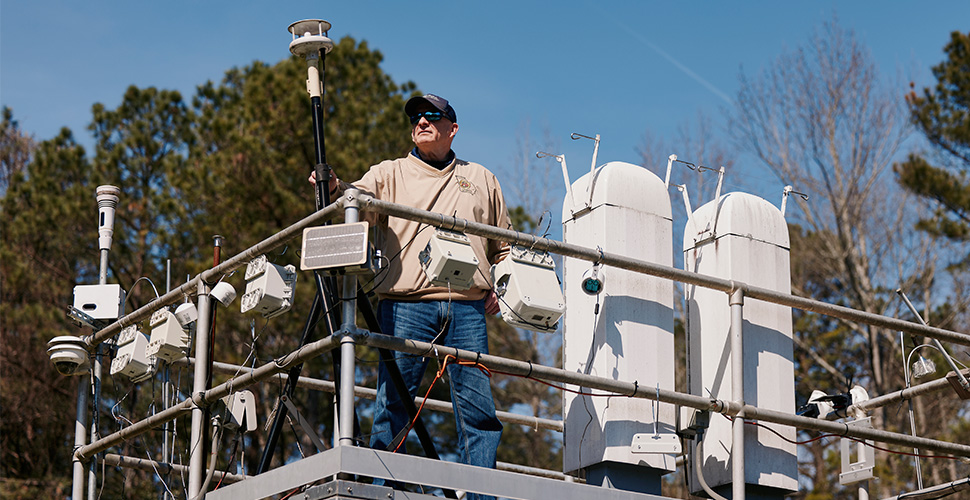
Atlanta residents can now breathe easier (literally) knowing that air quality in the city has steadily improved over the past 30 years. Thank the work of Georgia Tech’s Schools of Earth and Atmospheric Sciences and Civil and Environmental Engineering. Both have jointly helped power the Ambient Monitoring Program at the Air Protection Branch of Georgia’s Environmental Protection Division (EPD) for decades. To put things in perspective: In the last five years, the city of Atlanta averaged nine days per year when the air quality was considered unhealthy. Compare that to 1999, when 71 of 153 summer days were considered unhealthy. Not only has air quality improved, so has air quality forecasting. In 2025, forecasters made the right prediction 97% of the time.
“It’s been a great program that’s provided valuable information to everyday citizens, sports teams, and elderly residents alike,” says Bill Murphey, APhy 79, MS GeoS 84, PhD EAS 94. Murphey is the state climatologist for Georgia. There are many Yellow Jackets in the Air Protection Branch, including James Boylan, MS EnvE 99, PhD EnvE 02, the branch chief.
In a single year, a team of students and faculty can now issue 1,160 air quality forecasts, 214 ozone forecasts, and 366 PM (particle pollution) forecasts for Atlanta; 214 ozone forecasts for Macon; and 366 PM forecasts for Columbus alone. Serving cities throughout the state 365 days a year, the agency provides essential services that forecast 24 to 36 hours ahead to help protect citizens.
“Scientists from Tech have helped out a ton as far as developing and maintaining new forecasting tools and software, as well as helping us manage our day-to-day operations. They help us upkeep our daily models, maintain records, and calculate accuracy and overall performance,” Murphey says.
Every day at 1:30 p.m., the group—which includes meteorologists, climatologists, atmospheric chemistry pros, and others—convenes to assemble forecasts, which are subsequently pored over by everyone from concert planners to road race organizers and high school coaches.
1996 Olympics Air Quality
The initiative’s roots trace back all the way to 1995, with the impending dawn of the 1996 Olympics and an impromptu meeting at the Metro Atlanta Chamber of Commerce about the city’s then less-than-stellar level of atmospheric pollution. “At the time, Jackie Joyner-Kersee, who was then the world’s greatest athlete, had just told everyone she had asthma,” notes Michael Chang, AE 87, MS GeoS 92, MS PP 97, PhD EAS 97, former principal research scientist and deputy director at the Brook Byers Institute for Sustainable Systems at Georgia Tech. “The Chamber was worried that if she experienced an asthma attack, it was going to be a public relations fiasco.”
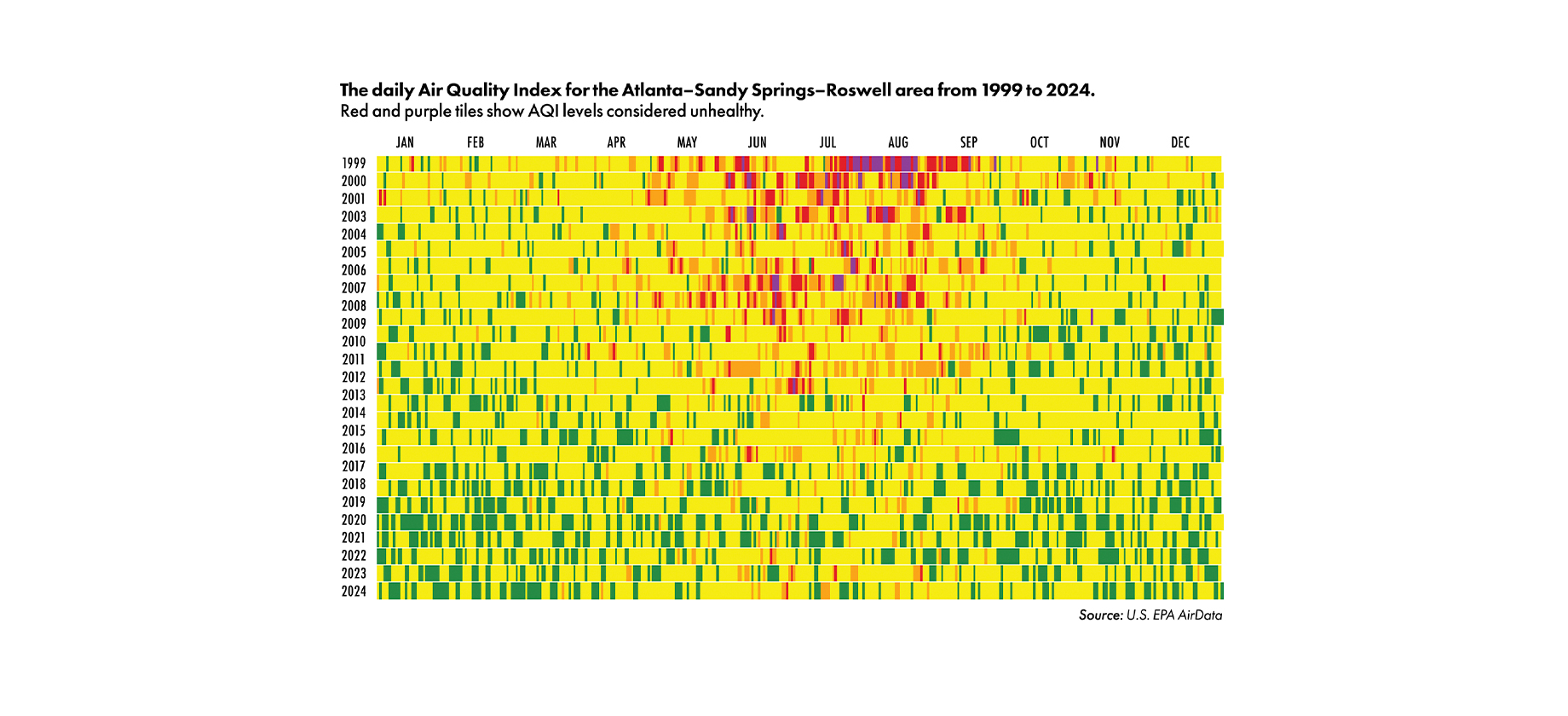 The daily Air Quality Index for Atlanta from 1999 to 2004 showing a steady improvement in the air quality in the city over the last 25 years.
Back then, he says, Atlanta had arguably the second-worst-quality air in the nation, topped only by Los Angeles. Thus city leaders at the time convened an emergency meeting with regulatory agencies and universities and anybody else who they thought could help. Officials realized that they couldn’t fix the problem in the next year, or know even how much the Olympics would impact matters overall. “So it was resolved that if we can’t fix it, maybe we can at least tell people when the air quality is bad so they can figure out what they need to do for themselves,” Chang says. “Nobody stepped forward to do the job, but we had a lot of world-class experts at Georgia Tech. At the time, I was in graduate school, but also working for the Georgia EPD. The vice president for Environmental Affairs of the Metro Atlanta Chamber of Commerce, who knew me well, pulled me to the side and asked if I’d volunteer. I thought it sounded like an interesting problem, so I said I’d do it!”
Georgia Tech Written All Over It
Beginning May 1, 1996, his hand-cobbled team began their work. Just one problem: “Back then, there were no protocols and virtually no one in the country was doing this work,” he says. “So we started coming up with statistical models and formulas just based on the mathematics and physics and chemistry of the atmosphere. It was all very inventive, very creative. We really didn’t have any constraints or direction. Which was good for the era—it allowed us to try a lot of different things really quickly!”
In the span of a couple months, the team started to find its footing and began to work with the state to formalize the process. Afterwards, it started to run workshops with local broadcasters and get local newspapers up to speed on what the team was doing.
“We knew we were having an impact when we started to see big corporations like Coca-Cola shift their operations and chemical companies adjust transportation efforts based on our forecasts,” Chang says. “And then we actually convinced the EPA to make this initiative more serious and formal and get some real resources behind it.”
Much has changed in air quality since they started. Still the group continues its good work, forecasting 24/7/365. They have 10 forecasters, and over the years, have had about 40, about half of whom are homegrown Tech talent. “This thing has Georgia Tech written all over it,” Chang beams proudly. “It’s been our baby since 1995, and as the longest project I’ve ever worked on, it’s personally taken me from graduate school to retirement.”
Thankfully, the tradition continues. “Between the rise of natural gas, solar, and nuclear generation and reduction in emissions from newer cars and EVs, Georgia’s air quality continues to improve,” says Murphey. “People are making smarter choices, carpooling and teleworking more, and leveraging forecasts and weather information to better plan their day and enjoy enhanced quality of life across the state.”