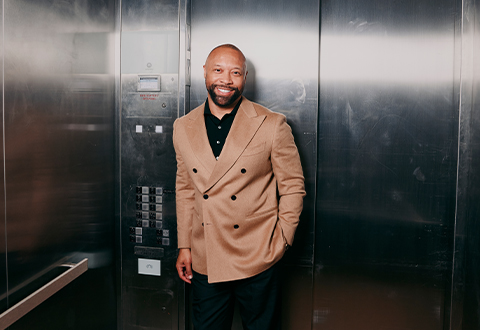
Reality Hits: Alumni Recall Their First “Welcome to Georgia Tech” Moments
By: Daniel P. Smith, Photography: Kaylinn Gilstrap & Art Meripol | Categories: Featured Stories

By: Daniel P. Smith, Photography: Kaylinn Gilstrap & Art Meripol | Categories: Featured Stories
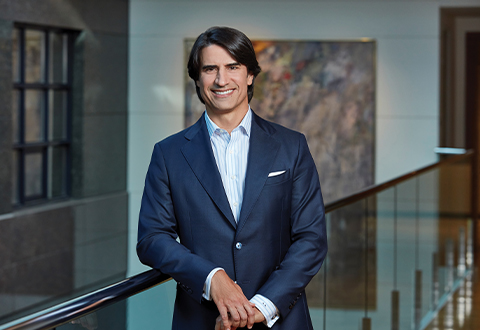
Alejandro Reynal, ME 94, MS ME 96, is the president and CEO of Four Seasons, one of the world’s most prestigious luxury hospitality brands. Reynal oversees a global, 60,000-employee enterprise operating more than 130 hotels and resorts, more than 60 branded residential properties, and experiential offerings such as the Four Seasons Private Jet Experience and Four Seasons Yachts.
I moved to the U.S. to attend Georgia Tech when I was 17 years old. Admittedly, I had a narrow view of life as well as my professional options at the time. I majored in engineering not because of any defined career plans but because I did well in math.
 Over my first two years at Tech, I largely put my head down and worked. As I progressed through courses and internships, my mind began to open up to different career possibilities. Georgia Tech was sharpening me for something, but exactly what, I didn’t yet know.
In my junior year, I became president of the Society of Hispanic Professional Engineers. That leadership role expanded my career horizons and gave me access to unique opportunities. When Coca-Cola CEO Roberto Goizueta came to campus to deliver a public talk, I was among a select group of faculty and student organization leaders invited to a private reception beforehand.
When Goizueta stepped into the room, you could feel his aura. He moved around the room greeting faculty and students. When he reached me, he saw my name tag and began speaking to me in Spanish.
As the reception was winding down and Goizueta walked toward the exit, I tapped his shoulder and said in Spanish, “Good luck with your speech.” He thanked me and smiled.
“Come with me,” he suggested.
When we arrived in the main auditorium, he gestured for me to sit in the front row among several Coca-Cola board members. It was his seat.
“Go ahead. Sit,” he said.
Polished and charismatic, Goizueta captivated the audience. He detailed his career and his stewardship of Coca-Cola. He mentioned his inspirations. During his remarks, he also dedicated to me the beautiful words of Spanish poet Antonio Machado: “Caminante, no hay camino, se hace camino al andar.” (Traveler, there is no path, the path is made by walking.)
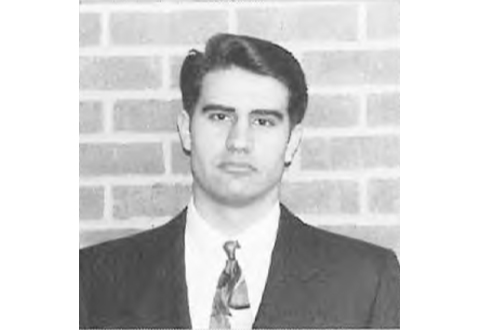 Goizueta inspired me on so many levels, from his upbringing to his professional accomplishments to, above all, the humanity he showed me, one of hundreds of Tech students present that day. Right then and there, I decided I wanted to become a CEO to positively impact the lives of others.
The power of the Georgia Tech brand made that moment possible, and it changed my life. It was a moment empowered by the premier reputation of Tech—a place that continues to attract executives from top companies to campus to interact with students. Access to Goizueta shaped my perspective and altered the direction of my life in such profound and special ways that I will forever be grateful.
A former Yellow Jacket football linebacker, Paul Hogg, IE 02, MBA 10, is the founder and CEO of Inteleca, a 17-year-old IT services and IT consulting firm headquartered in Smyrna, Georgia. The Atlanta native “caught the Tech fever” from his father, Brian Hogg, IM 61, an active member of the Georgia Tech Alumni Association and a regular at Georgia Tech sporting events.
Though I went to an academically rigorous high school, I managed the academic workload. Even though becoming a college football player earned much of my focus back then, honestly, I expected Georgia Tech to be much of the same—and for a while, at least, it was.
 I took five advanced placement classes in high school, so my first two quarters at Tech brought a lot of review. I breezed through and had a 3.8 GPA at the halfway point of my freshman year while acclimating to big-time football and enjoying Tech’s social scene.
Then, everything changed in the third quarter.
I came into Tech as a pre-med student but quickly realized that wasn’t my calling. I switched over to electrical and computer engineering and began knocking out some of the core engineering courses. I hit Differential Equations and tried to coast on prior knowledge. I couldn’t. My GPA in the third quarter was 2.5, which was a real wake-up call for me.
If I had any visions of success in the classroom and on the football field, then I needed to put in the work. There would be no shortcuts. No skating by. I had to put my social life in its proper place and figure out quickly a two-pronged approach prioritizing academics and athletics if I was going to earn the results I wanted for myself. I needed to mature, concentrate, and focus on getting the work done.
The third quarter of my freshman year delivered a learning experience I needed and led me to create the necessary processes that positioned me for success at Tech and beyond. With reflection and a more intense focus on my goals, I enjoyed so many significant milestones at Tech, from moving my major to industrial and systems engineering to being on the field as we beat Georgia 51-48 in 1999.
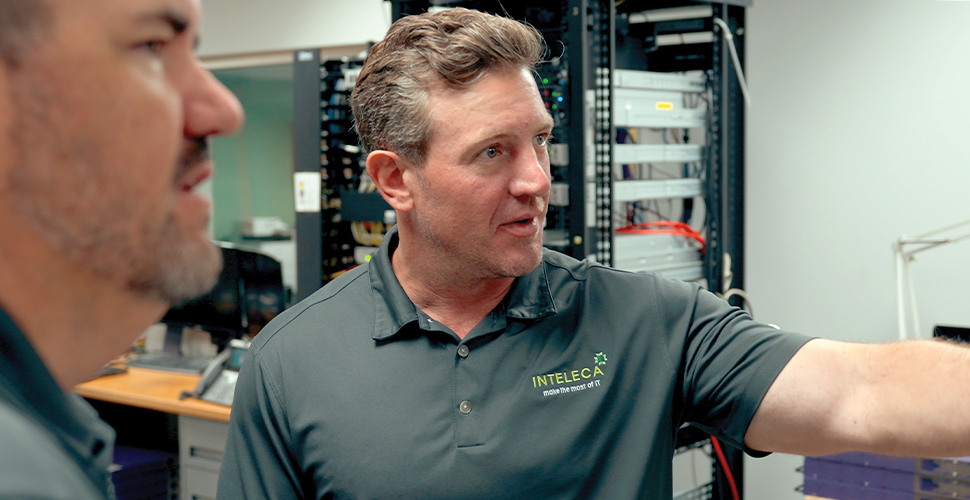
As a father, husband, and CEO today, I’m grateful for so many experiences I had at Tech, but the third quarter of my freshman year looms particularly large. I work hard in my career for myself, of course, but also because I want those I work with to be successful and achieve the results and lives they want as well. I attribute so much of this mindset to the discipline I gained during my freshman year at Tech and the realization I had to demand more of myself.
A former Yellow Jacket football linebacker, Paul Hogg, IE 02, MBA 10, is the founder and CEO of Inteleca, a 17-year-old IT services and IT consulting firm headquartered in Smyrna, Georgia. The Atlanta native “caught the Tech fever” from his father, Brian Hogg, IM 61, an active member of the Georgia Tech Alumni Association and a regular at Georgia Tech sporting events.
After spending the first decade of his professional career in sales at IBM, Marc Corsini, IM 80, shifted from the corporate world into entrepreneurship. Since 1992, Corsini has been an executive coach. His current roster features nearly 100 CEOs and presidents.
Growing up in Macon, Georgia, failure was foreign to me. I naturally thrived in athletics, the arts, and academics, where raw ability and last-minute effort usually carried me through. So, when I arrived at Georgia Tech as an architecture major with dreams of working alongside my father (Corsini & Father, I liked to joke), I assumed the success would continue.
Georgia Tech had other ideas.
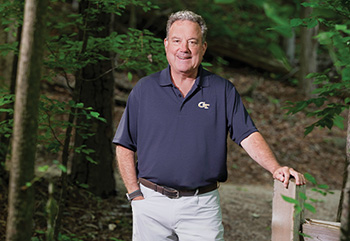 Architecture at Tech was demanding in ways I hadn’t experienced before. The workload was relentless. The expectations unforgiving. The pace didn’t slow for anyone—not for talent, confidence, or good intentions. Slowly, then all at once, it became clear I was in over my head. At the end of the third quarter, I flunked out—and not because I was having too much fun. I was actually trying and still flunked out, which made it especially demoralizing.
The emotional weight of that moment was heavier than the academic consequence. I was embarrassed. Ashamed. Disoriented. If I wasn’t “the guy who succeeds,” then who was I? Leaving Georgia Tech felt like a public acknowledgment that I wasn’t good enough, not only for Tech, but for the version of myself I thought I was supposed to be.
In hindsight, that moment was Georgia Tech’s greatest gift to me. It delivered a vital life lesson about perseverance when there’s no quick fix, when ability isn’t enough, and when the only option forward is humility, effort, and time. Setbacks, I discovered, are not verdicts but rather opportunities for growth.
While sitting out the fourth quarter of my freshman year, I wrestled with hard questions about my work ethic, my self-image, and whether I was willing to earn something the hard way instead of coasting. I decided to return to Tech, which wasn’t an obvious or comfortable decision. Intellectually and emotionally, I knew the academic rigor hadn’t changed. If anything, I knew more clearly how difficult it would be, but that was precisely why I chose to re-enroll at Tech rather than going to another school with lower academic standards. I wanted the honor of a Tech degree more than I wanted an easier path.
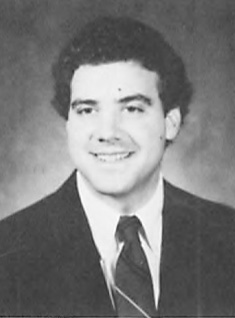 In returning to Tech, I changed my major to industrial management—a field better suited to how I learned and who I was becoming—and changed my entire approach to academics. I stopped relying on talent and started leaning into discipline. I asked for help. I showed up consistently. And this time, it worked.
What Georgia Tech ultimately taught me had nothing to do with architecture or management theory. It taught me that when everything feels stacked against you—when your pride is bruised, the path forward is unclear, and quitting would be understandable—hard work, dedication, and perseverance still matter. More than that, they compound. Slowly. Quietly. But relentlessly.
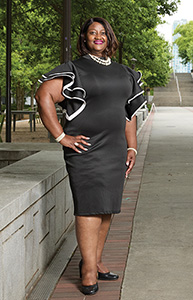
After a 24-year career at Procter & Gamble, where she worked across the enterprise in areas like supply chain, human resources, and customer service, Cynthia Culbreath, IE 93, MS IE 95, transitioned to academia in 2024. She is now the cyber policy program manager at Spelman College, where her projects include the institution’s newly launched Cybersecurity Clinic.
Near the end of my sophomore year of high school, my counselor told me about a week-long summer engineering camp at Georgia Tech. Now, when I heard “engineer,” I immediately thought of the person on the train wearing a blue cap. No one in my circle could tell me anything about the engineering profession. However, the chance to spend a week at Tech proved too enticing, so I signed up.
That one week changed everything. As we visited different engineers and learned about their roles, engineering’s connections to business fascinated me. I scrapped my existing 10-year plan—Harvard, then law school—and decided to major in industrial engineering at Tech.
I arrived on campus the smart kid. My entire academic career to that point featured a single B (in handwriting, of all things). But it didn’t take long to learn smart kids filled Tech.
Despite early self-doubt, I survived my first quarter at Tech and classes like physics and calculus. In the second quarter, though, I took electromagnetism. The class intimidated me and my anxiety swelled. Flustered, I consistently used my left hand to do the right-hand rule. I feared I was going to flunk out and lose my scholarship. When I called home and told my parents I didn’t think I was going to make it, my father presented an alternative: “Come home, go to the junior college, and major in spelling.” It was his way of telling me to stick it out.
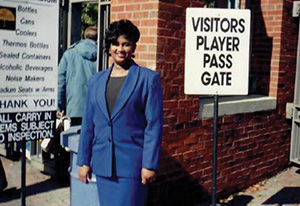 To save myself, I went to the Office of Minority Educational Development (OMED)—now the Office of Student Achievement—and was directed to tutoring. In high school, I was the tutor. At Tech, I became the tutee, forced to swallow my pride and accept help.
At OMED, I linked up with two tutors, Andre Marshall, ME 91, MS ME 93, and Tyrone Benson, EE 91, who made me feel at ease. They were welcoming, not condescending. They asked about my struggles, sat beside me, and listened. Genuine and caring, they explained things to me in a way that clicked, and their support made all the difference. I ended up getting a B in electromagnetism on my way to graduating with high honors.
Overcoming that academic challenge—the first in my life—gave me a different sense of confidence and an appreciation for the brilliant community present at Tech. I learned I didn’t need to do everything alone. I could give myself grace, build a squad around me, ask for help, and learn from the wisdom of others. Doing so represented strength, not weakness, and that lesson remains with me today.
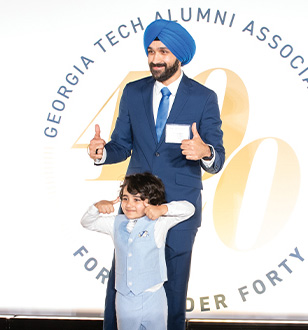
As the chief AI officer at GE HealthCare, Parminder Bhatia, MS CSE 15, leads the global company’s ambitious efforts to integrate artificial intelligence into the development, manufacturing, and operation of medical devices. His work at GE HealthCare over the last three years follows a nearly seven-year run constructing innovative Generative AI and Foundation models for Amazon. Bhatia is part of Georgia Tech’s 2025 Class of 40 Under 40.
Attending Georgia Tech became a bucket list item for me as I explored graduate schools in the U.S. after completing college and working in my native India. As I investigated different universities, it seemed the combination of Georgia Tech’s reputation, research strength, high-level faculty, and alumni base would help me take my career to the next level. A dozen years later, I can say Georgia Tech did that and more, though not necessarily how I envisioned.
I came into Georgia Tech focused on understanding gene sequencing and making advancements in that space. Within a week, however, my academic direction completely flipped.
At the start of the fall term, Tech allowed some flexibility in course selection. I was able to attend different classes before finalizing my course schedule, and I took full advantage of the opportunity. I had just walked out of a machine learning course when some friends suggested I follow them to an advanced natural language processing course taught by Dr. Jacob Eisenstein. “Why not?” I figured.
 I entered the massive lecture hall with few expectations and began listening to Dr. Eisenstein, a natural language processing expert who led Tech’s Computational Linguistics Lab. He noted how robust natural language processing could measure and understand language variation, which enabled AI systems to remain accurate and functional across diverse languages and dialects. Here, I saw something bridging humans and machines, and I was fascinated.
Within an hour, everything changed—my academic focus, my aspirations, and the trajectory of my life. Until this point, I had mainly been doing theoretical math and physics, and large language models weren’t at all on my radar. But Dr. Eisenstein’s class offered a home for applying theory into the real world, and I was blown away. This, I learned, was the magic of Georgia Tech: world-class faculty passionate about what they were doing and bringing students into their dynamic worlds and innovative work.
I got on the wait list for Dr. Eisenstein’s course, continued attending the class, and endlessly lobbied for a spot, eventually getting the final seat in the class.
Now, to be absolutely clear, the course was not easy. The curriculum was heavy and intense, and it pushed me far outside my comfort zone. As I had been working for three years before enrolling at Tech, I was also out of practice with advanced mathematical rigor. Nevertheless, I savored the challenge. Failure normalizes you. Failure humbles you. But failure also teaches you. I embraced The unknowns, battled through the intimidation, and gained confidence that has remained with me throughout my entire career.