Back to the Moon and Beyond: Artemis Mission Roles
By: Tony Rehagen | Categories: Alumni Achievements
For generations of scientists, engineers, and other NASA personnel, including many who were not yet alive in 1969, the Apollo Moon landing was a watershed moment—the first steppingstone of space exploration. So in 2017, when the agency announced that after 45 years the Artemis program would finally return humans to the lunar surface, many people working at NASA were elated.
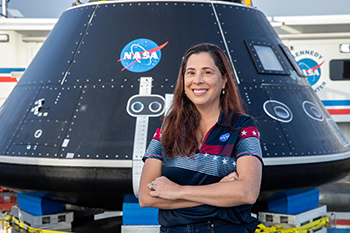
“We were finally doing what everyone wanted to do,” says Liliana Villarreal, AE 96, MS AE 97, who had helped process payloads for shuttle delivery to the International Space Station before being tapped as director of the Artemis II landing and recovery at NASA’s Kennedy Space Center. “Our team has always been thinking of going farther. That’s our driving ambition, our human instinct for exploration.”
A New Mission to the Moon
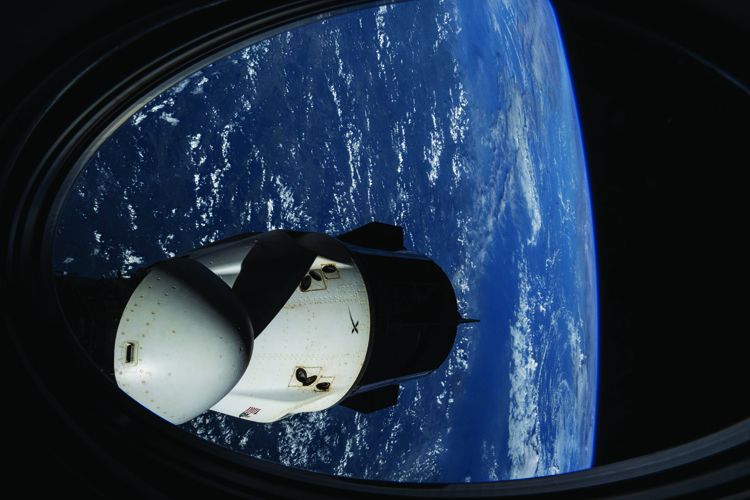
In many ways, this trip to the Moon will be different, Villarreal explains. Artemis is about going to the Moon to stay, to set up human settlements, and learn what it takes to survive and thrive in extraplanetary conditions. Launched in 2022, Artemis I was an uncrewed test flight of NASA’s Space Launch System (SLS) rocket and Orion spacecraft. (Among the flight directors preparing for this mission was fellow Tech grad Heidi Brewer, AE 05.) Artemis II will use the SLS to carry four astronauts around the Moon to test the equipment and crew in deep-space exploration, and Villarreal oversees the recovery of the crew and Orion capsule upon their return to Earth after their mission around the Moon. Artemis III will return humans to the lunar surface for the first time since 1972.
Planning for a Lunar Base
Of course, for people to survive on the Moon, they’ll need an independent source of water—essential for human life by itself and as a potential source of breathable oxygen, not to mention as a fuel and propellant. Here too, Tech alumnae were integral in sending ahead equipment to find and drill for water beneath the lunar surface. Jackie Williams Quinn, CE 89, and Janine E. Captain, PhD Chem 05, led NASA’s PRIME-1 team, which landed a combination space drill and spectrometer on the Moon in March 2025. The lander ended up on its side, so the drill wan’t able to operate, but the spectrometer was still able to gather crucial data, which was computer-modeled with help from Georgia Tech’s Regent’s Professor Thomas Orlando. “It operated flawlessly,” says Quinn. “The landing environment was more rugged than we had thought, but we showed that we could take commercial equipment and modify it to enable long-term habitation on a celestial body.”
The wide range of roles that Georgia Tech graduates have in getting humanity back to the Moon underscores the team effort involved in undertaking such an endeavor. In fact, there’s a Yellow Jacket in NASA’s administrative offices helping oversee the entire project. “You’re not going anywhere without the people on the ground,” says Casey Swails, Mgt 07, NASA’s Deputy Associate Administrator. “Everyone sees the rockets and the landers, but they don’t see the people who make these missions happen. We rely on universities like Georgia Tech that are forward-leading, with students pushing boundaries and thinking about things differently. It doesn’t matter your major—I switched out of engineering. There is space in space for everyone.”
Artemis II Gets a Lift from Yellow Jackets
Artemis II, which launched April 1, 2026, was the first crewed mission to the lunar orbit in more than 50 years and the farthest that humans have traveled from earth.
Dozens of alumni contributed to NASA’s historic mission, from Shawn Quinn, EE 90, who led the team responsible for systems that processed and launched the rocket and spacecraft to Liliana Villarreal, AE 96, MS AE 97, who oversaw the astronauts’ safe return as Artemis II Landing and Recovery director.
Below, see a list of alumni who are helping the agency explore the Moon and lay the foundations for crewed missions to Mars.
Yellow Jackets Contributing to Moon Missions
- Alexander McLaughlin, MS CS 12, Simulation Software Engineer, worked on simulating telemetry coming off the rocket for the validation of software systems and training of the launch team.
- Andrew Brown, MS ME 85, PhD ME 98, Structural Dynamics, Propulsion (retired), performed structural dynamic analysis on RS-25 core stage rocket engines.
- Van Chatraw, IE 76, Senior Systems Engineer, supported Marshall Space Flight Center System Engineering in the design and development of SLS.
- Will Judd, ME 99, Liaison Engineer / Technical Lead Engineer, worked on the Core Stage of the SLS rocket. He supported the build of Core Stages and integration for Artemis I and II.
- Jean-Pierre de la Croix, CS 10, EE 10, MS ECE 12, PhD ECE 15, leads NASA’s CADRE project, which will demonstrate multi-agent autonomous exploration of the lunar surface.
- Christine Du Quesne, ME 04, Branch Chief of Fluids & Contract Management, responsible for NASA’s liquid propellants and specialty fluids for Artemis.
- Shaun Heath, EE 90, Information Systems Subject Matter Expert, provides data integration management for Exploration Ground Systems.
- Max Geissbuhler, AE 20, MS AE 21, Senior Manager, Orbital Analysis, led ground-based tracking efforts to monitor the trajectory of Orion.
- Aaron Hawkins, EE 07, Viasat, RTE Business Manager, manages antenna networks that collected telemetry data.
- Meredith Ivey, ChE 93, SLS Propulsion IPT Analyst, responsible for tracking purchase requisitions and parts for Core Stage rockets.
- Ricky Lehner, ME 17, provided engineering expertise for the design and construction of mechanical systems at Kennedy Space Center.
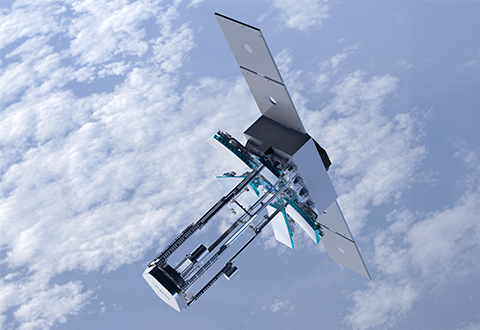
- Kavya Manyapu, AE 06, serves as a spacewalk specialist and lunar surface operation technical assistant.
- Roger Lascorz Guiu, AE 14, MS AE 16, EHP Imagery System Manager, responsible for imagery of the lunar surface.
- Ulises Nunez Garzon, AE 17, MS AE 20, PhD AE 23, Artemis II Nominal Mission Co-lead for Orion Mission Design Team.
- Ellen Proper Brown, IE 85, Systems Engineering and Integration Division Manager for ARES Corporation.
- Russell Ralston, ME 12, AE 14, Executive Vice President of EVA for Axiom Space, designing new lunar spacesuits.
- Luke Roberson, Chem 99, MS Chem 02, PhD Chem 05, and Daniel Yeh, PhD EnvE 00, creating next-gen water recycling systems.
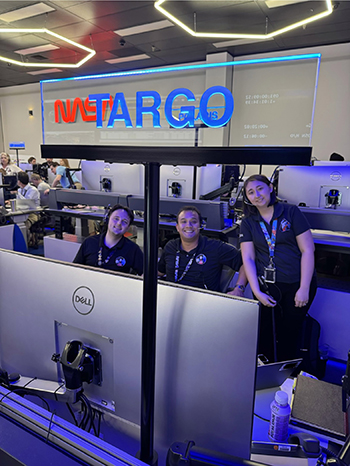
- Malik Russell, CmpE 17, extravehicular activity flight controller in Mission Control.
- Casey Swails, Mgt 07, NASA’s Deputy Associate Administrator.
- Jackie Williams Quinn, CE 89, and Janine E. Captain, PhD Chem 05, led NASA’s PRIME-1 lunar drill team.
- Kenneth Smith, MS AE 18, Deputy Launch Director at Blue Origin.
- Russell Scott, ME 84, Lockheed Martin Engineering Senior Staff, is the Lockheed Martin Orion Grounds Operations Lead.
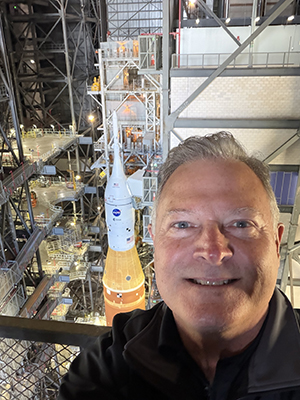
- Shawn Quinn, EE 90, Manager of the Exploration Ground Systems program.
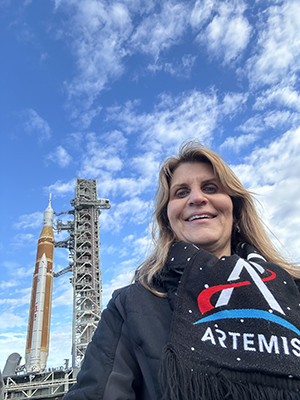
- Liliana Villarreal, AE 96, MS AE 97, Director of Artemis II landing and recovery.
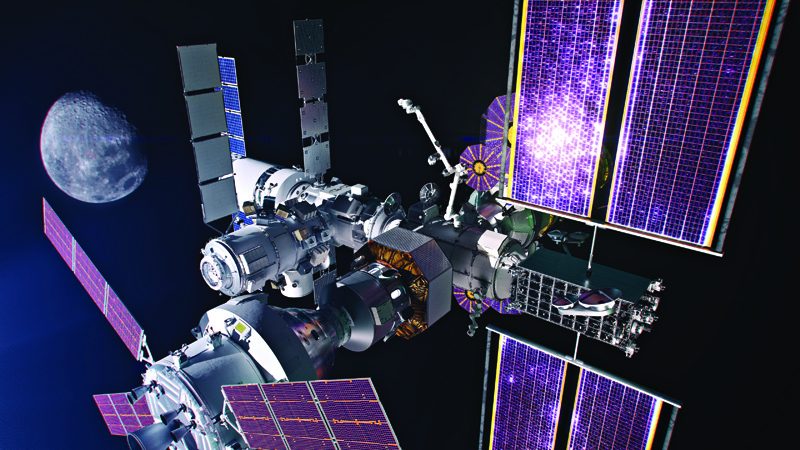
- James K. Orr, AE 71, Gateway Avionics Architecture lead.
- Antony Williams, AE 82, Associate Director, EVA Systems Engineering and Integration.
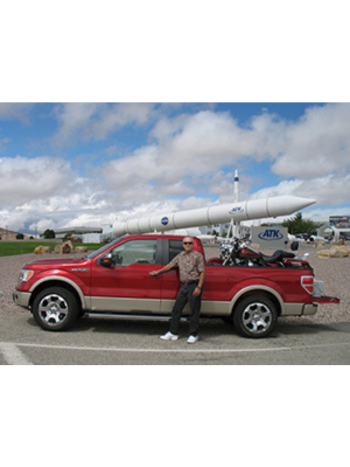
- Roger Whitesides, ME 61, MS ME 62, NASA MSFC Engineering Consultant.
- Kyle Yawn, AE 13, Intravehicular Activity Branch Chief, NASA Flight Operations Directorate.