Unlimited Space: Launching a Space Technology Company
By: Eric Butterman, Photography courtesy of SuperSharp Space Systems | Categories: Alumni Interest

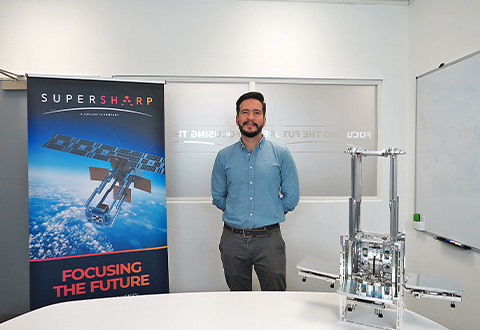
For Marco Gomez-Jenkins, AE 11, ME 11, it’s all about a clear vision. These days as cofounder and CEO of Cambridge-based SuperSharp Space Systems, he is preparing for an early 2027 scheduled launch of his company’s first high-resolution thermal-imaging satellite, which will launch from a SpaceX rocket.
“The unfolding space telescope allows you to fit very large telescopes in small packages, launching a small box and deploying a telescope for 10 times the resolution per unit cost,” he says.
This satellite will be about the size of a washing machine and will operate in lower orbits of 500 kilometers (310 miles) in altitude. It will allow for the creation of global temperature maps, which can be useful for agriculture and energy efficiency.
“It’s heavily related to climate change because the dynamic temperature maps, for example, can monitor the energy efficiency of buildings,” says Gomez-Jenkins, who also co-founded the Costa Rica Institute of Technology’s Space Systems Laboratory. “It’s a big problem in Europe, in particular, because of the age of some of the infrastructure. We can help to identify buildings for retrofitting to help with emissions when it comes to cities. Our technology also can detect heat stress in crops. This way, before physical changes occur, you can see crops that are dehydrated. It’s an early warning system that can help boost overall yields of the season.”
 An Aerospace Career Launched
Growing up in San José, Costa Rica, it was hard for Gomez-Jenkins to see an aerospace career in his future, but it was his time at Georgia Tech that put it in focus.
He remembers one lecture, in particular, by Georgia Tech Professor Lakshmi Sankar.
“The professor’s enthusiasm and knowledge was part of the spark for my career,” says Gomez-Jenkins. “You had professors who had worked for JPL and on Mars rover missions, and hearing their experiences opened my mind where I could see that a career in the space industry was something that was really plausible. I can tell you that if Georgia Tech didn’t have an aerospace engineering program, I would not be doing what I’m doing today.”
Gomez-Jenkins started looking into creating his own company because he had seen companies like SpaceX develop their own satellite constellations or their own rockets, he says. “Before SpaceX came along, the industry was dominated by space agencies and big contractors. It’s now changed, and it’s demonstrated that you can build a space company and provide products and services and grow the industry overall.”
As he awaits the first quarter of 2027 for his company’s satellite launch, he sees it as the next opportunity in a career where imagination, teamwork, and entrepreneurism can mix for success.
“From solving the problem of space debris to the opportunities of the lunar economy—not just sending people to the Moon but exploring its possible resources and building permanent space stations—it’s a time of unlimited possibility.”