Shooting for the Moon
By: Colleen McNally Arnett | Categories: Alumni Achievements
 Farah Zuberi, AE 12, in her role as director of Spacecraft Mission Management at Firefly Aerospace reached new heights in March 2025 when the Blue Ghost lunar lander successfully touched down on the Moon.
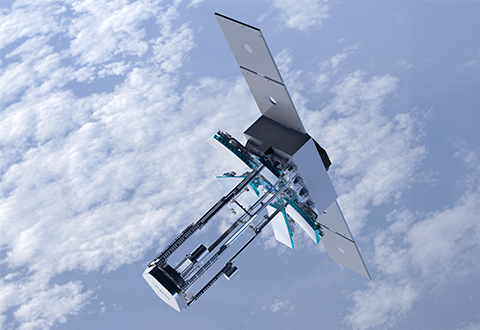
Part of NASA’s Commercial Lunar Payload Services initiative, the 14-day mission achieved many firsts: tracking GPS signals on the Moon, robotically drilling and collecting data from deeper in the lunar surface than ever before, and capturing high-definition imagery of a total solar eclipse—ultimately paving the way for future exploration.
Like its namesake (a rare Blue Ghost lightning bug from Southern Appalachia), the science behind the lunar lander is mystifying and hard to grasp.
This is where Zuberi comes in. As the director, she is responsible for ensuring customer satisfaction across multiple payloads and leading different subsystem teams to make them all happen. One day, she is helping the Structures & Mechanisms team design a robotic arm. Next, she is supporting the Propulsion & Guidance, Navigation, and Control teams to capture an image during a critical burn. Another day, she is involved closely with the Thermal Control Substance team on heat conductance.
She was on console at 2:34 a.m. on Sunday, March 2, when the Blue Ghost touched down. “I had several dreams about landing on the Moon, and I would get upset when I would wake up and that wasn’t reality. Then, it actually happened and it was so much better than all of the dreams.”
After a short celebration, it was back to work. “You only get so much time to do everything you want to do before your spacecraft becomes nonoperational,” she adds. “For me the job wasn’t done, it was just beginning.”
The 14 days that followed included long hours, late nights, and many sacrifices. “It’s hard to sleep and hard to not be at work when you’re doing something on the Moon,” she recalls.
Zuberi joined Firefly in 2021. Her celestial aspirations trace back to childhood, when her father often took her to visit NASA’s Johnson Space Center. She chose Tech for its top-ranked Aerospace Engineering program.
Still, some of the most critical lessons came outside of the classroom. Zuberi studied abroad in France, interned at NASA, and captained the Goldrush dance team. That ability to choreograph a team—all while juggling a difficult course load—parallels the leadership skills required to direct 10 payloads at once. “Georgia Tech taught me a lot about time management, setting goals, and skills that weren’t even technical. It helped me succeed in ways I didn’t really expect.”
That also includes forming a network of fellow alumni within Firefly, like Allen Butler, AE 16, the director of Spacecraft Integration, Test and Launch Operations, and Robby Ainsworth, AE 16, who serves as an Assembly, Integration and Test Engineer on the Blue Ghost team.
More Blue Ghost voyages are planned, including a $176.7 million contract from NASA to deliver five payloads to the Moon’s south pole in 2029. “Whatever we learn is impacting the decisions that will be made for humans returning on the Moon,” Zuberi says. It’s a goal that keeps her shooting for the stars.
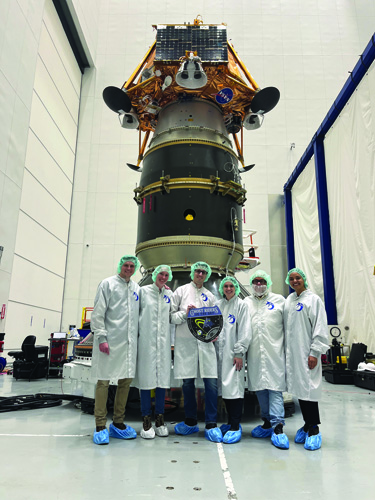
Photo: Farah Zuburi (far right) and Allen Butler (far left) with Blue Ghost, which is integrated with the launch vehicle payload adapter.