Tech's Spin-offs: Turning Research into Business
By: Jennifer Herseim | Categories: Alumni Interest
In fiscal year 2025, Georgia Tech reported record-breaking numbers in research commercialization, with more than 460 new invention disclosures and 124 patents issued. Backed by a strong startup ecosystem, more researchers are translating breakthroughs in the lab into viable companies that solve real-world problems. To strengthen that startup mentality, Georgia Tech even has a vice president of commercialization and chief commercialization officer. Serial entrepreneur and former CREATE-X director Raghupathy “Siva” Sivakumar assumed the role in the fall of 2021.
Below are just a few of the successful companies that have spun out of Georgia Tech research:
Micron Biomedical
A pioneer in the field of microneedle technology, Mark Prausnitz founded Micron Biomedical with Sebastien Henry and Devin McAllister in 2012. Rather than use a traditional needle injection to deliver vaccines and medicines, Micron Biomedical offers drug delivery that can be painlessly self-administered with dissolving microarray technology. It could redefine vaccination and drug delivery.
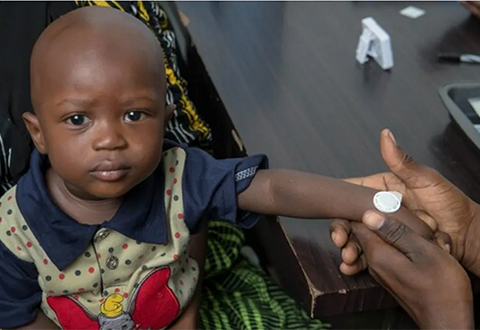
Micron’s patches have already been used in clinical trials to deliver measles and rubella vaccines in The Gambia. Prausnitz, who is a Regents’ Professor and Regents’ Entrepreneur, has launched several companies based on microneedle research, including a separate company that has an FDA-approved product to treat inflammation in the eye. Prausnitz is the J. Erskine Love Jr. Chair in Chemical and Biomolecular Engineering.
Cardiosense
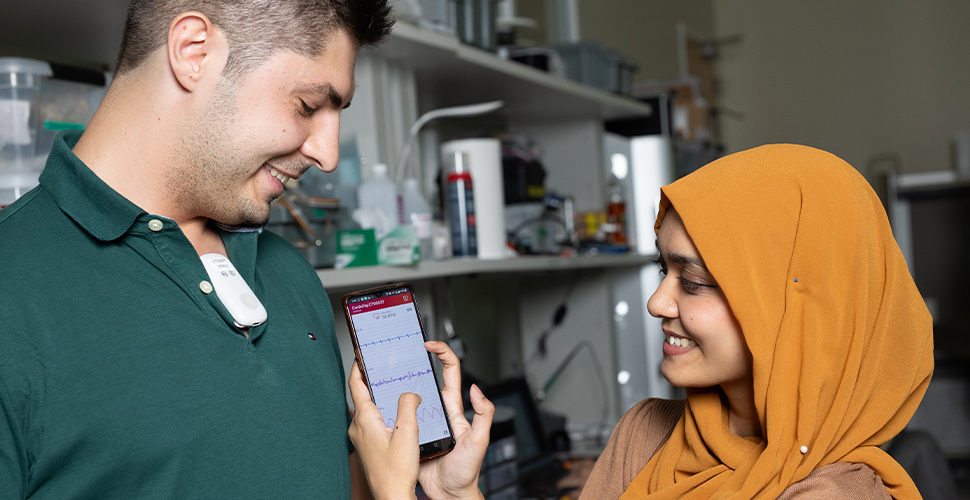
Tech Professor Omer Inan has spent decades researching non-invasive physiological monitoring. In 2020, he cofounded Cardiosense, which combines a wearable device with AI to detect early signs of cardiac disease before symptoms appear. The company’s CardioTag sensor, which earned FDA 501(k) clearance, non-invasively monitors cardiac mechanics, electrophysiology, and peripheral blood volume pulsatility.
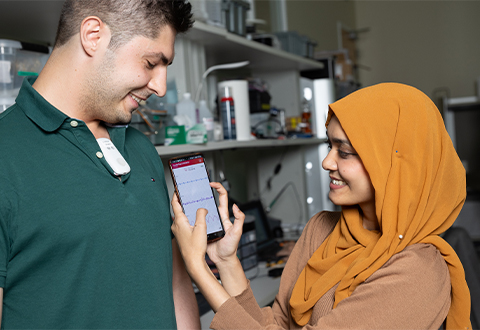
AI algorithms analyze three types of signals captured by the sensor—electrocardiogram (ECG), photoplethysmogram (PPG), and seismocardiogram (SCG)—to output an estimate of cardiac filling pressures. The technology could help provide earlier interventions that save lives. Inan is Regents’ Entrepreneur, associate chair for Entrepreneurship and Strategic Initiatives, and Linda J. and Mark C. Smith Chaired Professor in the School of Electrical and Computer Engineering.
Sanguina
Approximately 1.9 billion people in the world live with the blood condition anemia. One of those is Erika Tyburski, BME 12, who began working on an instant anemia screener while she was a student at Georgia Tech.
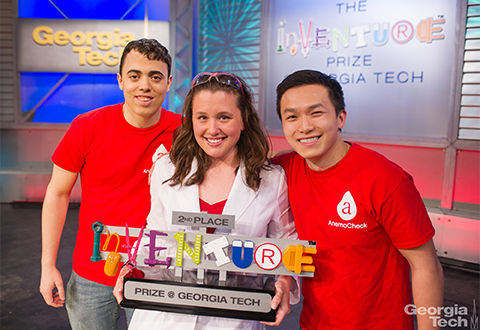
She met Rob Mannino, BME 13, PhD BME 18, who also has the condition. In 2013, the two took second place at Tech’s InVenture Prize with their first AnemoCheck prototype, a disposable screening tool for anemia. One year later, they launched Sanguina, and in 2023, the FDA cleared AnemoCheck Home, the only FDA-cleared home anemia test with instant results.
Andson Biotech
When Mason Chilmonczyk, MS ME 17, PhD ME 20, was a postdoctoral researcher at Georgia Tech, he developed a breakthrough technology to make the development and production of cell and gene therapies easier.
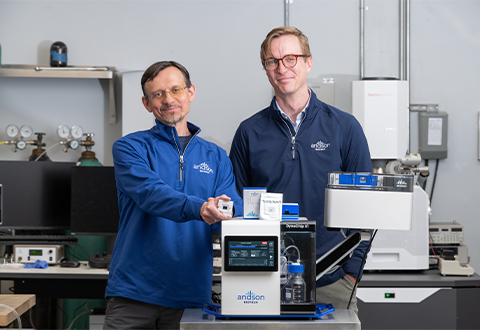
He developed a microfluidic device that significantly cuts down the analysis time of traditional mass spectrometry, which is essential for developing biotherapeutics, from hours to minutes. With Tech Professor Andrei Fedorov, he co-founded Andson Biotech, a biotools company to commercialize the innovation through their DynaChip platform technology. The innovation simplifies sample preparation for mass spectrometry, and the technology has the potential to accelerate the development of established biotherapeutics (monoclonal antibody-based therapies) and emerging modalities (mRNA and gene and cell therapies).
Tap into Tech’s Angel Network
The Georgia Tech Angel Network connects Tech founders to a strong network of Tech alumni entrepreneurs for capital, mentorship, and contacts. The group includes successful alumni entrepreneurs, such as Chris Klaus, Cindy Bi, and Sean Henry, who help fellow Yellow Jackets scale their businesses. Interested Tech founders can submit a pitch deck, team details, and a link to their website to get started. They will typically receive a check-in from an angel within 2 to 3 weeks.
Visit GTangelnetwork.com to learn more.