To the Red Planet - Yellow Jackets & Mars
By: Tony Rehagen | Categories: Alumni Achievements
Growing up in the 1980s with dreams of one day becoming an astronaut, James Wray always thought it was a shame that he was born too late to become the first person to walk on Mars, an achievement that, back then, seemed imminent. Forty years later, Wray regrets that he’s now probably too old to accomplish that still-unfulfilled goal.
But as a professor in the School of Earth and Atmospheric Sciences at Georgia Tech, Wray is one of the many Yellow Jackets doing their part to set the trajectory and clear the landing ground for humanity’s overdue visit to one of its closest neighbors. “Exploration is at the core of our species,” says Wray. “Mars is the most sensible place to start that expansion. It’s the most Earth-like planet, and it’s one of the closest. It’s also a great place to test whether life is emergent in all planets, or if Earth is unique in that way. If there has never been life on Mars, I personally become a little more pessimistic of finding it anywhere.”
 Wray and a team of NASA researchers found a potentially groundbreaking clue to that mystery when they were studying images of the planet’s surface and noted several dark streaks that appeared on the slopes of craters during warm periods that disappearred when the temperature dropped. Using the Compact Reconnaissance Imaging Spectrometer for Mars (CRISM) on the Mars Reconnaissance Orbiter, the team was able to analyze these lines and detect the presence of hydrated salts—the kind that precipitate from liquid water. Planetary scientist and Tech grad Lujendra Ojha, PhD EAS 16, was the lead author of the 2015 report. “Liquid water is a key requirement for life on Earth,” Ojha told Space.com at the time. “The presence of liquid water on Mars’ present-day surface therefore points to environments that are more habitable than previously thought.”
More recently, in 2025, Wray was part of another Tech group that discovered Jezero Mons, what they believe to be a composite volcano, including volcanic rocks that might provide more hints about the Red Planet’s geological history and whether past hydrothermal activity might have provided a hospitable setting for microbial life. Wray and his fellow scientists might get to analyze these rocks firsthand because they are being collected by NASA’s Perseverance rover—and for that, they can thank fellow Yellow Jackets.
Philip Twu, PhD ECE 12, worked as a robotics system engineer on Perseverance. As supervisor of the Robot Operations and V&V Group at NASA’s Jet Propulsion Lab, he oversees the team that handles mission operations for every NASA robot currently on the surface of Mars. One of Twu’s biggest contributions was being system engineer for the rover’s autonomous navigation system, including hardware, software, and algorithms that enable Perseverance to cover more ground and perform more science in its mission to gather priceless samples from the planet’s surface for an eventual Mars Sample Return mission to Earth. Currently, Twu and his colleagues at JPL are figuring out exactly how the rover will transfer those rock and regolith samples to the Mars Ascent Vehicle, which will then launch a container of samples into Mars orbit to be captured by an Earth Return Orbiter for their trip home, all robotically. “We’ve never brought anything back from the surface of another planet,” says Twu. “It will be challenging. But I want to answer the big questions in life. Where do we come from? Where are we going? We’re a step closer to finding out.”
Yellow Jackets Contributing to Mars Missions
- Philip Twu, PhD ECE 12, worked as a robotics system engineer on Perseverance. As supervisor of the Robot Operations and V&V Group at NASA’s Jet Propulsion Lab, he oversees the team that handles mission operations for every NASA robot currently on the surface of Mars.
-
Luke Walker, AE 09, MS AE 12, MBA 12, was a systems engineer on the Mars rover Perseverance. Today, he’s a program manager at Astrolab.
-
David Way, MS AE 97, PhD AE 01, led the Mars Science Laboratory and Mars 2020 Entry, Descent, and Landing simulations. Today, he’s the Earth Delivery Phase lead for Mars Sample Return.
-
Elizabeth (Deems) Córdoba, AE 05, was the Mars 2020 payload lead systems engineer. She led the systems engineering team to develop and test seven instruments on the Mars rover Perseverance.
-
Mallory Lefland, AE 12, was an Entry, Descent and Landing systems engineer working on the design and testing of the landing behavior of the Mars Perseverance rover.
-
Ian Clark, AE 03, MS AE 06, PhD AE 09, was a project systems engineer for Sample Cleanliness, Office of the Chief Engineer on Perseverance, and is now the Mars Ascent Phase lead for the Sample Retrieval Lander.
-
Kareem Badaruddin, EE 86, MS EE 87, was supervisor for System Testbeds, Spacecraft Operability on the Mars 2020 mission.
-
Shivaly Reddy, MS ECE 06, worked on motor control flight software on the Mars 2020 mission, which included the rover and the descent stage.
-
Jason Ginn, AE 13, MS AE 14, was aeroshell cognizant engineer on the Mars 2020 mission.
-
Alyssa Deardorff, AE 18, was a systems engineer on the Flight and Mission Systems teams for the Perseverance rover.
-
Emily Bohannon, ME 19, is a systems engineer, who worked on the mission operations and systems testbeds for Mars 2020.
-
Mike Pauken, MS ME 90, PhD ME 94, served as thermal systems engineer on Mars 2020.
-
Jessica Clark, AE 10, MS AE 12, was a fault protection systems engineer at NASA’s JPL, who worked on both the Mars Perseverance rover and the Curiosity rover.
- Chester "Tony" Ong, AE 06, MS AE 13, led surface operations for Mars Phoenix lander, contributing to the discovery of water ice on Mars, and supported spacecraft cruise verification testing for Mars Curiosity Rover.
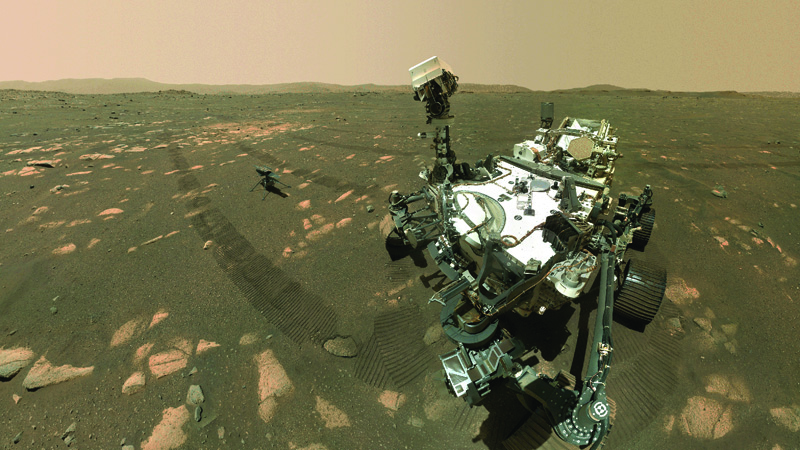
(Top photo) The Perseverance rover poses for a selfie with the ingenuity helicopter. (Credit NASA/JPL-CalTech/MSSS)
Mars photo (Credit NASA)