4 Career Change Lessons From Georgia Tech Alumni Who Reinvented Themselves
By: Brian Hudgins, Photos courtesy of alumni | Categories: Featured Stories

American workers are on the move. About half (47%) are considering a significant career shift in 2026, up from 27% a year ago, according to a survey from the hiring firm Robert Half. And 70% are considering switching jobs within the next two years, according to a survey by LinkedIn.
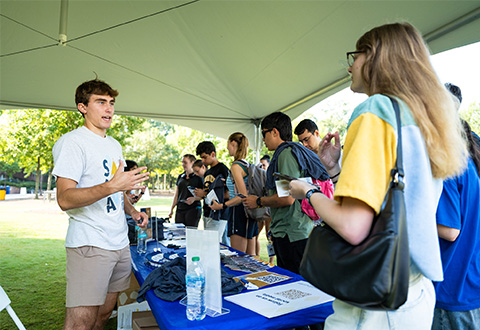
For anyone looking to quit, pivot, or make a bold change, Michael Newborn, MBA 15, has some advice. He’s not only been in your shoes as an 18-year veteran of the tech industry turned podcast host, he also speaks about pivoting like it’s his job—because it is.
Newborn, MBA 15, is the cofounder of the Second Act Movement and creator of the podcast “The Second Act,” where he and his co-host John Ballenger talk with guests who have walked away from a conventional path. Several have been Yellow Jackets, including Eileen Nebhut, MBA 21, and Ron Johnson, MS OR 85.
“See what’s out there in the world and don’t be afraid of failure,” Newborn says. “You never know what’s going to happen.”
Whether you’re forced to pivot or seeking a change, starting from scratch can be daunting. Yellow Jackets who have been there offer these rules to help smooth the transition.
Rule #1:
Process the Change.
"Whether your career change is because of the loss of a loved one, an illness, or a financial change, it's the loss of something significant in your life. Processing that change puts you in a better position to move forward."
Dave Wethington, ChE 04, had established himself in product development at Procter & Gamble and Diversitech Corporation when the Cincinnati, Ohio, native heard his diagnosis right before Thanksgiving in 2012. A brain tumor was affecting his brain stem, cerebellum, and carotid artery. His doctor’s message was a single sentence: “We need to get this thing out now.”
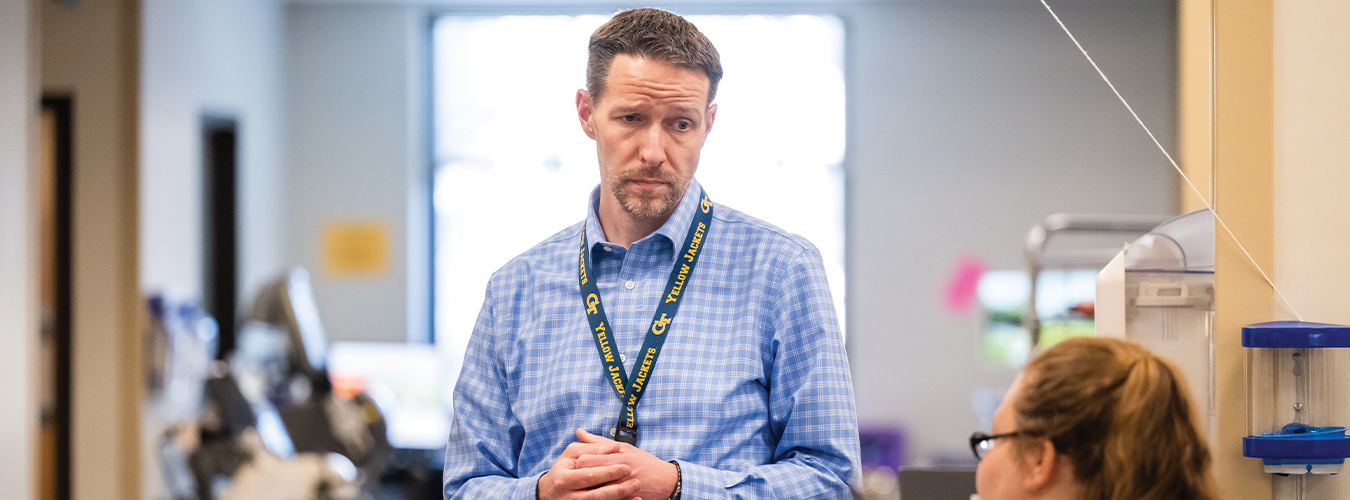
Brain surgery was put on the schedule for a week after Thanksgiving. Wethington’s journey through therapy and recovery at Shepherd Center involved relearning how to walk and talk. Although he regained those functions, he felt he had lost his purpose.
His medical team at the center told him that he would likely be doing basic work from a wheelchair for a year if not longer. “When I was at breakfast, the hospital chaplain (Alan Roof) talked with me about finding meaning and purpose,” Wethington says. “He said, ‘You are encouraging other patients because you are in the midst of rehabilitation just like they are.’”
When Wethington and his wife, Allison, BioChem 03, became parents a year later, Wethington realized he needed to recalibrate. He became a stay-at-home dad and started taking online seminary courses. Wethington then moved to Houston to begin full-time seminary and began volunteering with a local hospital. During his time volunteering, a hospital chaplain asked him if he had ever considered chaplaincy as a career. Those few statements from Roof and his peers in Houston helped Wethington make a sudden career shift. He became a chaplain at Houston Methodist Hospital. Then, he moved back to Atlanta in June 2020 during the height of the Covid pandemic to become a chaplain at Shepherd Center.
“It was definitely a journey to get from where I was to where I am,” Wethington says. “I never dreamed I would go from driving up and down Peachtree Street at Tech to working just off campus. Coming to Shepherd and coming back to Atlanta was an opportunity we couldn’t pass up.”
Wethington loved everything he did in product development and engineering before his pivot to ministry provided opportunities to connect with patients’ families and give them hope for the future. “The resilience and perseverance needed to get through those study sessions at Tech give you the confidence to make significant career changes,” Wethington says. “Tech is an amazing opportunity. You never know where life will take you.” —Brian Hudgins
Rule #2:
Recognize You Have Transferable Skills.
"In hindsight, a sudden career shift will be hard. It will be scary, but you have the skulls that translate. You have more skills and knowledge than you think."
Dr. Victoria Fritz, Bio 17, was in the first month of her medical residency as a cardiothoracic surgeon in training when a Type 1 diabetes diagnosis necessitated a new track. “It was not safe for me or my patients (to handle this workload) as I got sicker,” Fritz says. “I thought…I will die in this hospital. It made me understand my own mortality more.”
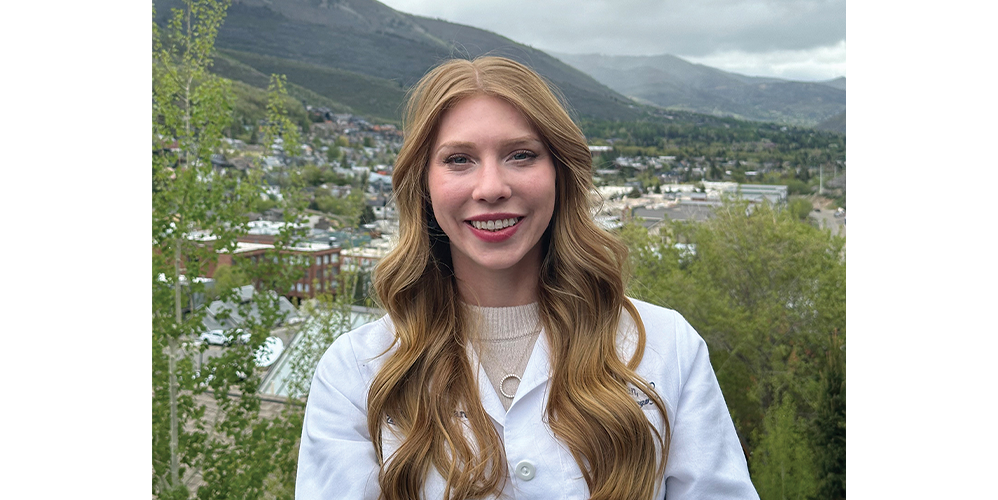
At the same time, Fritz and her husband, Marshall, ChBE 18, found out she was medically unstable for pregnancy. The need for a surrogate prompted Fritz to found Surrogacy Matchmaker, a California-based company that matches surrogates and families. “The surrogacy industry relies on women in difficult financial situations,” Fritz says. “That translates to instability on things such as food and housing. It leads to higher risk. The industry had targeted these women by paying them $25,000 to $40,000 to be a surrogate. Surrogacy Matchmaker’s mission is to triple and quadruple these payments to reflect the value surrogates bring to society.”
The company’s mission is clear and fueled by her own experiences: Match future parents who are willing to pay higher rates directly with potential surrogates who have high educational backgrounds and low-risk lifestyles. Fritz had the idea in March 2024. Becoming operational and finding clients took several weeks. “A few weeks felt like years,” Fritz says.
Draw On Skills Learned at Georgia Tech
Fritz relied on the tools she gained as a biology/pre-med major at Georgia Tech and input from a variety of sources. She sent out cold emails asking people for 15 minutes. She reached out to Melissa Heffner, the associate director for Tech’s VentureLab, who helped Fritz’s startup become part of the RIoT Accelerator Program in 2024.
Fritz also found San Francisco accommodating. “When you are starting out with very little money, it makes you focus on the details. Georgia Tech helps you become a problem solver by thinking creatively and openly. San Francisco reminds me of a giant Georgia Tech.”
She has secured surrogate compensation to the $150,000 to $250,000 mark, with a goal to continue to go higher. Fritz’s career pivot from doctor to surrogacy matchmaker is a personal path. “I want to get higher compensation for surrogacy and higher respect for women giving birth.” —Brian Hudgins
Rule #3
Embrace and Enjoy Uncertainty.
"If you are going to do it—embrace it, cut the cord, and have fun!"
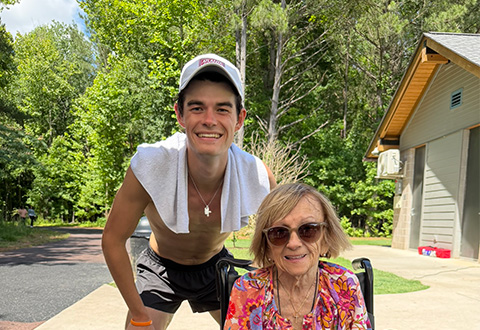
Steven Small, IE 80, and his wife, Taryn, had been living in Boston for a decade when she said five transformative words in 2002: “Let’s move to New Zealand.”
Small had served as a test engineer for a computer company—followed by working for a few startups—when his next career move came 9,000 miles away. “We had been to New Zealand twice before,” Small says. “When we applied for work visas in New Zealand, the application process was hard. When the embassy came back and said ‘You match,’ we sold our house, cars, and other belongings in 90 days and went on that journey without looking back.”
Be Open To Saying Yes
They made the move in June of 2002. The Louis Vuitton Cup was set to start in October in Auckland. The event was a selection series that determined which sailing teams would move on to compete for the America’s Cup. “We had years of racing experience in Narragansett Bay, Rhode Island,” Small says. “We were asked if we wanted to participate in the Louis Vuitton Challenger Series? Hell, yes!”
Steven served as a course setter and Taryn was a course marshal for a six-month term.
The high-profile international sailing event provided opportunities to meet people in other fields. New Zealand filmmaker Peter Jackson filmed The Lord of the Rings trilogy from 2001–’03, shining a spotlight on the nation as a destination for TV commercial and film crews. “A lot of U.S. companies were making commercials and films in New Zealand because it was less expensive and the talent was already there,” Small says.
Small signed with a talent agency, which enabled him to get a foot in the door. He worked as an extra in the 2004 TV drama Ike: Countdown to D-Day. Small later got a role as a featured extra (a bartender) on the long-running New Zealand soap opera, Shortland Street. The series is centered on fictional Shortland Street Hospital in Auckland.
When Small met Dr. Brian Russell, a biomedical engineer and the founder of Zephyr Technology, Small welcomed another career transition. Russell developed remote physiological status monitoring systems for military and healthcare personnel. “We did medical monitoring before the iPhone and smartwatches were available,” Small says. “We received U.S. investment (in Zephyr) and moved operations to Annapolis, Maryland.”
Tech-Built Perseverance
Small credits Tech for providing a huge challenge long before he and Taryn took off to New Zealand. “Tech is a real uphill struggle…one of the hardest things I have ever done,” Small says. “The perseverance and self-reliance stay with you the rest of your life.” —Brian Hudgins
Rule #4
Find Your Community.
"Just start talking with people. Have a conversation with no agenda about the outcome and you might get a spark for what your next thing will be."
After interviewing dozens of people who have made a monumental change in their lives for his podcast “The Second Act,” Michael Newborn, MBA 15, and his co-host started to notice commonalities among their guests.
“There are really five main characteristics that we’ve seen through our conversations with them,” says Newborn. Those are:
- Courage: They have the courage to take the first step and try something new.
- Community: There’s a strong community around them. “With that, they have the realization that when they step out to try something new, there are many people willing to help,” Newborn says.
- Grit: They have a willingness to roll up their sleeves and figure it out. “They know things won’t go exactly to plan, but they believe they’ll find their way to the next step,” he says.
- Purpose: They have a desire for more purposeful or meaningful work. “They’re seeking a more meaningful impact on their family, friends, community, or the world, especially compared to when they started out of school,” he says.
- Faith: They have an element of faith in something greater than themselves. “Everyone has talked about some element of faith, no matter their spiritual belief, to help them find the courage, the grit, and to steer the ship,” Newborn says.
Newborn’s own “second act” came after working in the technology industry for 18 years with four different companies, never truly taking a weekend off.
“I found myself thinking, ‘If I could have any job in this industry, what would my dream job be? And I couldn’t come up with an answer. In hindsight, that was a sign,” he says.

A conversation with his career coach at the time led to the two teaming up to start a podcast.
Almost three years later, they’ve produced more than 80 episodes with insights on what it takes to realize the path you’re on is no longer working and how to make a change. “I had no idea that I would be doing this for this long and be able to talk to people all over the world and learn from their stories,” Newborn says.
Several of those guests have been fellow Tech alumni.
“I would say there’s definitely a risk tolerance that Yellow Jackets have and they put on their strategic thinking hats,” he says. “With Yellow Jackets, it’s not an uninformed leap into the unknown. It’s very much an informed leap into the unknown.”