Georgia Tech’s 2026 World Cup Roster
By: Jennifer Herseim | Categories: Featured Stories
Nearly 1.42 billion people watched the Men’s World Cup final in 2022 (roughly 11 times more than the most recent Super Bowl). When the 2026 World Cup kicks off this June, it’s expected to draw even more viewers. For the first time in FIFA history, the tournament will include 48 teams and be hosted across three countries: Canada, Mexico, and the U.S.
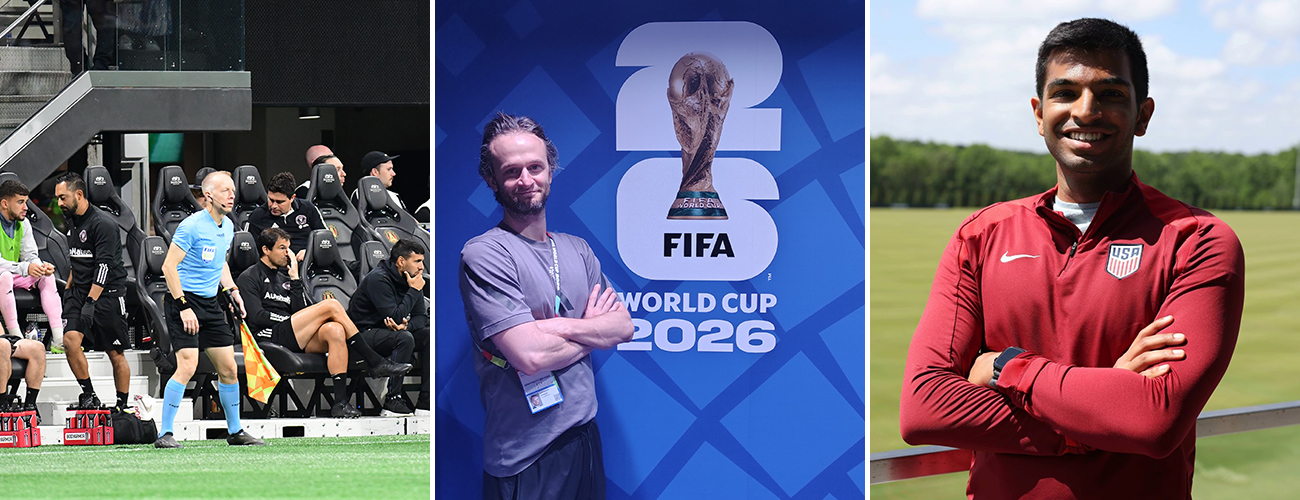
“The scale and scope of this sporting event is unprecedented in human history,” says Usayd Casewit, MS PP 17, who serves as the Venue Workforce Manager for FIFA’s official hospitality provider, On Location. Casewit is based in Kansas City, one of 11 American host cities.
In addition to Casewit, Abby Barsky, BA 17, is a business development manager on FIFA’s Gaming team. Tech alumni also work at the U.S. Soccer Federation in data analytics, product management, and strategy.
Akshay Easwaran, CS 19, is a senior data engineer on the U.S. Soccer Federation’s Data Analytics team, which is one of the largest soccer analytics programs in North America. On the fan engagement side, Keisha Bradley, CE 06, serves as a product manager for U.S. Soccer’s core web and mobile platforms. Jathan Caldwell, IE 22, is also at the U.S. Soccer Federation, serving as a strategy manager. Zunairah Jamal, CS 27, is a product design intern for U.S. Soccer's digital platforms. Jillian Augello, BA 28, is interning for U.S. Soccer as a strategy analyst for the Corporate Affairs team. AC Davis, BA 28, is working in operations strategy as an intern for the Coaching Education team. Akhil Kumar, BME 13, is a senior manager of Coaching Technology at the U.S. Soccer Federation, focusing on the federation's coaching education digital strategy and programming.
While Tech alumni won’t be playing or refereeing in the 2026 World Cup, Corey Rockwell, IE 98, previously took the pitch as part of the U.S. referee crew at the 2018 World Cup in Russia. In April 2025, he also became the first Major League Soccer (MLS) referee to reach 400 regular-season games.
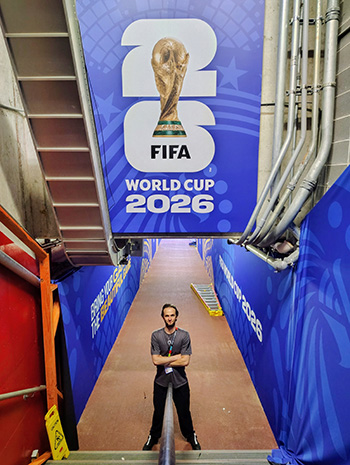 FIFA Hospitality
At Arrowhead Stadium in Kansas City, Casewit serves as the workforce manager for the venue’s hospitality team, delivering a once-in-a-lifetime experience for fans and high-profile guests.
“My role is to make sure that everyone is collaborating, and the scheduling is in place, with the overall goal of delivering the best possible hospitality experience for On Location’s guests,” he says. Inside private suites, guests from around the world will taste culinary dishes tailored to each host city.
Having the World Cup in the U.S. is personal to Casewit, who grew up in Morocco and remembers watching the 1994 Men’s World Cup on T.V., when it was also hosted in the U.S. “I remember watching that final between Brazil and Italy that summer of ’94 as a kid and being mesmerized.”
Pursuing a Dream Job in Sports
While a lifelong fan, Casewit is relatively new to the sports industry.
In 2017, as a master’s student in the School of Public Policy, he helped found Georgia Tech’s Global Change Program with President Emeritus G. Wayne Clough. In 2023, Casewit transitioned from a successful career in climate policy and sustainability with the World Bank and the U.S. National Academy of Sciences, to pursue a dream job in sports. “I was proud of the work I did in climate science and sustainability, but sports was always my thing. Then I turned 35, something in my heart just snapped, and I said I have to pursue this dream.”
After leaving with no job lined up, he drove from Washington, D.C., to Cincinnati for a weeklong, unpaid role at the Cincinnati Masters 1000 tennis tournament, working 12-hour days. He went back to school, earning a degree in Sport Management, and joined the International Paralympic Committee, helping countries around the world invest in parasports. He worked at the Paris 2024 Paralympic Games, FIFA Club World Cup 2025, and FIFA Final Draw 2025, before his current role at the FIFA World Cup 2026.
The decision to start over in a new industry felt like a “now or never” moment and he doesn’t regret it. “I am extremely passionate about sports and the power it has to bring people together and to promote peace and understanding,” he says. In 2025, he was named a member of the Georgia Tech Alumni Association “40 Under 40” class for his leadership and achievements in international development, sustainability, and sport.
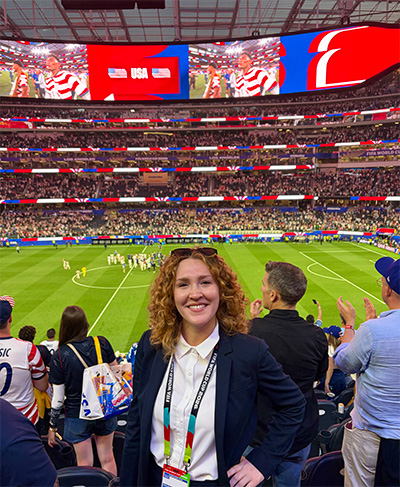 FIFA’s Gaming Team
If you’ve played FIFA games Heroes, Rivals, or Super Soccer, which is the largest branded game on Roblox with more than 12 million monthly active users, then you’ve experienced some of the games that Abby Barsky, BA 17, supports as a business development manager on FIFA’s Gaming team.
Barsky manages FIFA’s gaming partnerships and leads new business efforts across mobile, console, and PC gaming initiatives.
The 2026 World Cup is Barsky’s second time being part of the games. In 2014, she attended a 2014 World Cup practice game in Buenos Aires, Argentina, as part of Georgia Tech’s Study Abroad program. Barsky says her role at FIFA is a full-circle moment.
U.S. Soccer Federation Data Analytics Team
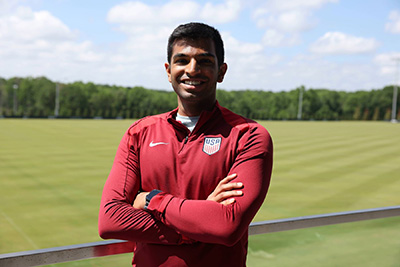 The data analytics team at the U.S. Soccer Federation supports 27 national teams from the Women’s and Men’s U.S. National Teams to the U-14 squads and extended teams like futsal, beach soccer, Cerebral Palsy national teams, and the Power soccer team, the first competitive team sport developed for powerchair users.
As a senior data engineer at U.S. Soccer, Akshay Easwaran, CS 19, builds tools and applications so that coaches and video staff can make informed decisions. They use data from a variety of sources such as GPS, optical tracking systems, and event-based data streams.
Analyzing a Quick-Moving, Fluid Sport
Dissecting the beautiful game into discrete data points can be more challenging than with other sports, Easwaran adds.
“Soccer is a quick-moving, fluid sport. The ball goes in the back of the net and that’s the end of the play, but the play that actually unlocked that goal could have happened five, six, or seven seconds before that,” he says. “You have to find specific stints of time to make a very continuous sport discrete.”
A Home for U.S. Soccer
In May, the U.S. Soccer Federation moved into its new headquarters at the Arthur M. Blank U.S. Soccer National Training Center, just south of Atlanta in Trilith, Ga. The 200-acre site features 17 outdoor grass and turf fields, an indoor high-performance gym, and dedicated space for all U.S. Soccer staff.
“It’s like soccer Disneyland,” Easwaran says. “This is the home for soccer in America, and we’re committed to using this space as a force for good.”
Easwaran’s interest in sports analytics started at Georgia Tech, where he was able to intern with technology companies and work on sports-based software projects. In school, he worked on a text-based iOS game called College Football Coach, helping port the game from an Android platform. “It scratched an itch I had that I could actually blend sports and technology,” he says.
He hopes the upcoming World Cup will inspire others with a similar interest.
“Bringing this tournament to our shores gives other kids the opportunity to have these kinds of dreams… to say maybe I could be there one day or work on one of these staffs one day,” Easwaran says.
Yellow Jacket Reflects on Officiating a World Cup Match
Only the most elite officials are chosen to referee the World Cup. As preparations ramp up for the 2026 World Cup, one Tech alumnus knows what it takes to officiate at that level. 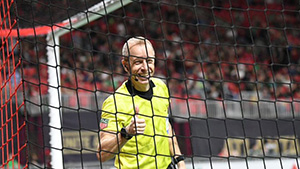 Yellow Jacket Corey Rockwell, IE 98, was selected as part of the U.S. officiating crew for the 2018 Men’s World Cup in Russia. “They released the press release at the same time around the world, so I remember it was 3:30 in the morning my time and my phone just started blowing up,” he says.
Even after being selected, there wasn’t a guarantee that he would ever take the pitch during the tournament. Twenty-one days in, the four-person U.S. officiating crew was finally called up to referee a match between Belgium and Tunisia. “We got there 45 minutes before to warm up, and I took a moment to soak it all in—the fans were already starting to make noise and I thought about the millions who would be watching around the world—and then I got into game mode.”
Belgium won 5-2 in one of the highest-scoring matches in that World Cup. Fans remember the excitement from the game, but not the refereeing, just as Rockwell and his team wished. “We were thrilled,” Rockwell says.
Balancing a Career While Refereeing at the Highest Level
Rockwell started refereeing while he was a student at Georgia Tech to pay for his tuition. “I would go to class, come home to study for a few hours, and then grab my referee bag to head to a local high school game.” 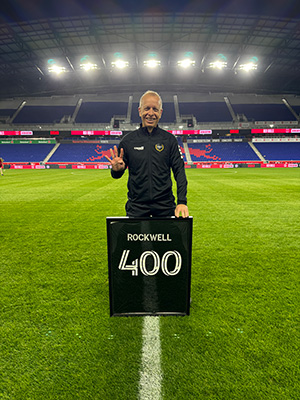 Those time management skills have come in handy. In addition to being a top-level referee, he’s also a vice president of Red Lobster. He uses vacation time to travel around the country to MLS matches. “Obviously I can’t lie about what I do to work because they’re going to flip on the T.V. and see me running down the soccer field.”
Aside from the time commitment, refereeing is both mentally and physically demanding. Rockwell averages 7 miles a game as a center referee. As an assistant on the sidelines, he might run 4.5 miles, most of which is sprints to keep up with the players.
As a proud alumnus whose license plate reads “Ga Tech,” Rockwell credits the Institute for preparing him for soccer and for the highly emotional situations he faces on the field. “Georgia Tech prepares you for any kind of situation. I mean, if I can pass thermodynamics, I can handle 90 minutes with a bunch of teenagers on a field, calling a game.”
Despite retiring from FIFA officiating in 2023, Rockwell’s love for the game carries on.
“I love the sport and I literally have one of the best seats in the house right there on the field.”
Email additional Yellow Jacket World Cup connections to editor@alumni.gatech.edu