You Got Out of Georgia Tech, But Could You Get In?
By: Jennifer Herseim, Photo by: Ben Rollins | Categories: Alumni Interest

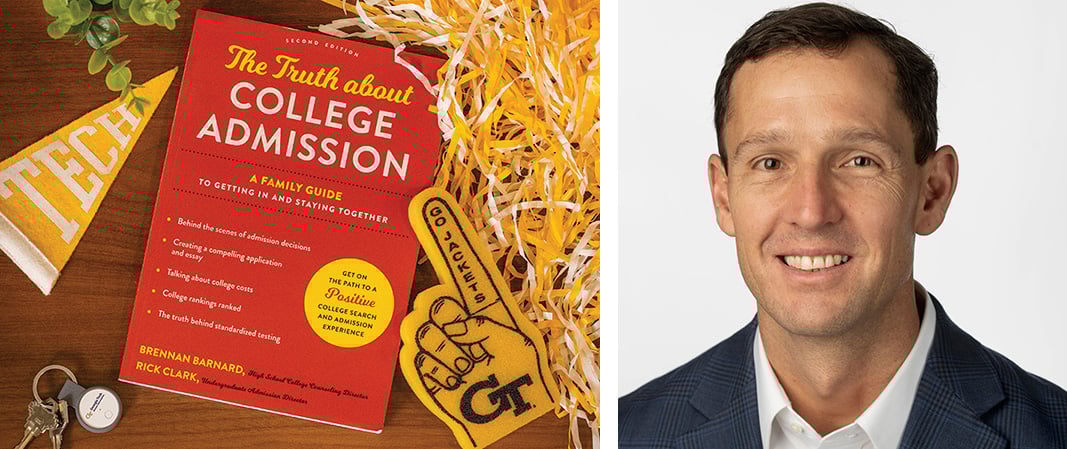
Over and over, Rick Clark, Georgia Tech’s vice provost for enrollment management, has heard variations of this line from alumni, many of whom are highly successful individuals.
One is John Brock III, ChE 70, MS ChE 71, HON PhD 16, retired chairman and CEO of Coca-Cola Enterprises. Brock has often said, “I didn’t go to a top 10 school, but I have a degree from one.” He attended Tech in the 1970s, graduating with a bachelor’s and master’s in chemical engineering before going on to lead one of the most recognizable companies. He, like his fellow Tech graduates, left the Institute prepared to change the world. “I started at Georgia Tech in 1966, and it was a highly respected and thought-of school then, but it’s nothing like today,” he says.
In the decades since then, Tech’s secret has gotten out.
The number of students applying to Georgia Tech has grown for 18 consecutive years. Before 2007, Tech received less than 10,000 applications annually.
In 2025, applications were up to nearly 67,000. For most of Tech’s history, the acceptance rate has hovered above 50%. In 2013, it began to sink below 50%. Last year, the acceptance rate was just 13%.
Impressively, even as more students apply to Georgia Tech, the yield rate—the number of students who are accepted and choose to enroll at Tech—has increased. More students are not only applying, but they’re also choosing Tech over other options. If you’re wondering if you could still get into Tech today, take a look at these numbers to learn more about Tech’s soaring competitiveness.
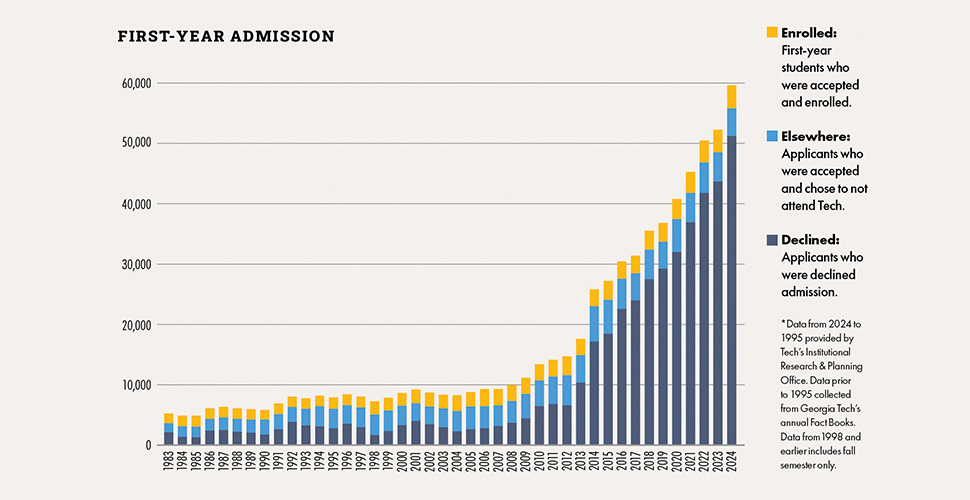 Since 1983, the number of students applying to and enrolled at Georgia Tech has increased enormously. *Data from 2024 to 1995 provided by Tech's institutional Research & Planning Office. Data prior to 1995 collected from Georgia Tech's annual Fact Books. Data from 1998 and earlier incudes fall semester only.
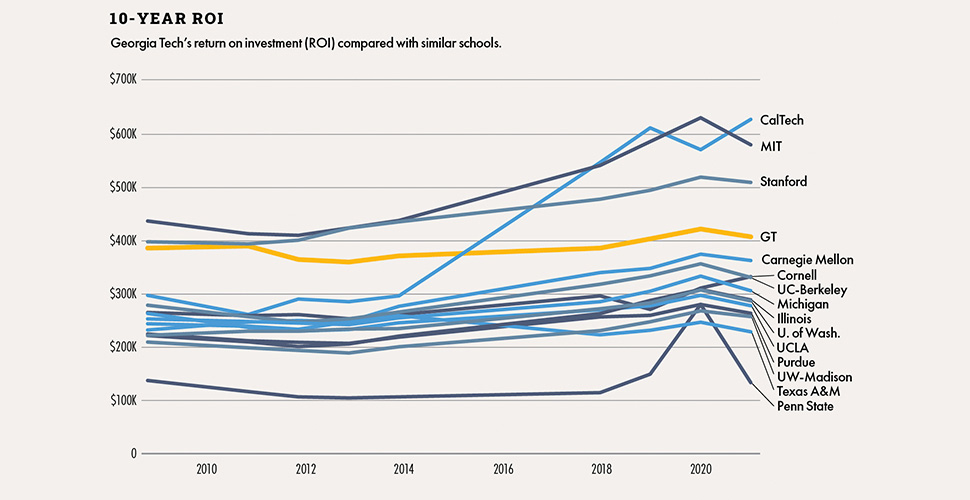 Graph presenting a comparison of the 10 year ROI between Georgia Tech and similar schools around the US.
Why Demand Exploded
Clark jokes that alumni are partly to blame. “Our alumni have gone all over the world and told people how great Georgia Tech is and how it changed their lives,” he says.
Indeed, the Institute has evolved from a regional powerhouse to a world-class producer of talent.
When Mary Tipton Woolley, executive director of Undergraduate Admission, arrived at Georgia Tech in 2009, the Institute received about 300 international student applications. Last year, that number was 12,000.
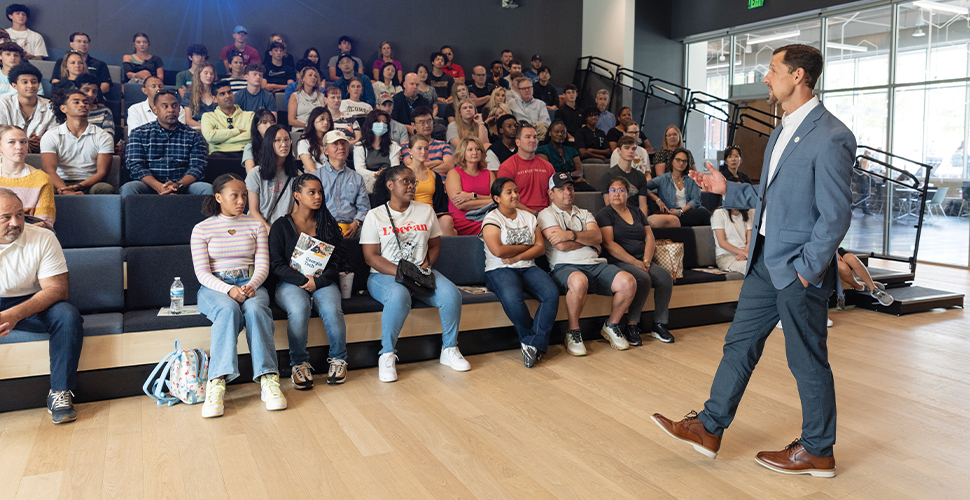 National trends are also contributing to the surge in applications. In the 1990s, high schoolers might send applications to one to three colleges on average, Woolley says. Today, they apply to eight to 10 schools on average, and it’s not uncommon to hear of students applying to 15 or more.
Not only are high schoolers applying to more colleges, but they are also graduating from high school in higher numbers and more are choosing to attend college. (Indicators show these trends will start to reverse, Woolley adds.)
“This is both a Georgia Tech phenomenon and a flagship public university phenomenon. But I think Georgia Tech was on the forefront,” says Woolley.
 Brock credits Georgia Tech leadership over the last decade for accelerating the school’s evolution while keeping what Georgia Tech has always been known for unchanged. “For me, Tech helped me realize that hard work, resilience, competitiveness, and communication are all important to succeed in business. I think today there are even more opportunities for students, more undergraduate research projects, faculty involvement, and care and concern for students,” he says.
The Sweet Spot
The national trends aren’t enough to explain Georgia Tech’s soaring competitiveness. Something’s happening at Tech that’s not happening elsewhere.
“Georgia Tech is really in this sweet spot,” Woolley says. “We offer a strong STEM education in a large metropolitan city that’s easy to get to, and it’s a global city. There’s the cost and value of a Tech degree, and on the non-academic side, students are drawn to Tech’s rich history, traditions, and school spirit—Georgia Tech is a really attractive place.”
 In 2024, The Wall Street Journal reported that more Northern students are flocking to schools in the South, searching for a better experience and better cost. The article, which led with a photo of the Ramblin’ Wreck leading the football team onto the field, named Georgia Tech as one of the top schools in the South that’s drawing in Northern students.
“Athletics is a very important part of the college experience,” Brock says. He recalls a story when he and his wife, Mary, who is an honorary alumna of Georgia Tech, were talking with their daughter about colleges. He told her counselor in a Connecticut prep school that his No. 1 requirement was a school that plays Division I football. “Saturday afternoon football in the Southeast is as good as it gets, right?” he says.
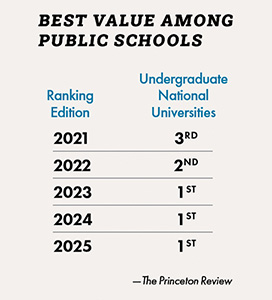
For value, Georgia Tech can’t be beat. The Institute has claimed the No. 1 spot for Best Value among public colleges three years in a row from The Princeton Review. Tech’s return on investment is in the top 20% compared to peer institutions, and it’s the highest ROI of all colleges in the University System of Georgia.
Growing & More Selective
Georgia Tech isn’t only becoming more selective, though; it’s growing, too. “Our selectivity is going up while we’re growing at unprecedented rates,” says Georgia Tech President Ángel Cabrera, MS Psy 93, PhD Psy 95. “Normally, you’d say, ‘Well, you’re growing so much, so you must be less selective.’ But we’re growing and being more selective at the same time.”
By 2030, Georgia Tech aims to double the number of degree and non-degree learners, which would mean conferring 15,000 total annual degrees to graduates and undergraduates. The Institute is well on its way. Last year, Tech saw the largest incoming class in the Institute’s history, with 4,050 first-year students and 1,400 transfer students.
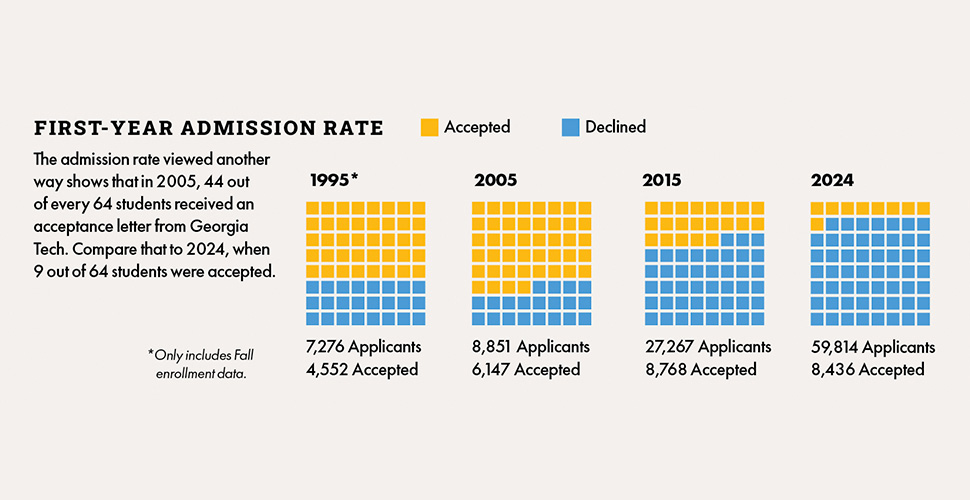 The percentage of applicants admitted to Georgia Tech has declined from 1995 to 2024. In 1995, 44 out of 64 students were admitted. In 2024, only 9 out of 64 were admitted.
Tech’s total enrollment increased to 53,067 students last spring, an 11.4% increase from the previous spring. A large part of growth is due to the Online Master’s Program, which now has more than 21,000 learners enrolled. The first few years of the Online Master’s program created a significant spike in Tech’s growth. Another spike occurred in 2014 with the Institute’s switch to the Common Application.
“We asked similar schools what we should expect during the switch to the Common App,” Clark says. “They all said between a 20% to 25% increase the year that they switched; we had a 48% increase.”
The Common Application allows students to apply to multiple colleges using one application. In the past, Tech used a formulaic admission process. Great grades and strong test scores added up to an acceptance. “When you have a large volume of applicants who are highly competitive, the formula breaks down,” explains Woolley. There are not enough spots for students who would normally qualify. Today, Tech’s admission process is more holistic, taking into consideration additional factors, such as the level of courses a student takes in high school and the impact they’ve made on their school and community. Admission also balances the academic composition of the first-year class.
You Might Still Get In (Just Differently)
While it’s harder than ever to get into Georgia Tech, being declined admission as a first-year student is not the end of a dream to become a Yellow Jacket. Nine pathway programs offer avenues for students to transfer into Tech. The Conditional Pathway Program enables legacy students (with Georgia Tech alumni parents, siblings, or grandparents) who exhibit strong academic credentials and meet the transfer admission criteria to transfer to Tech. Approximately 1,400 transfer students enroll each year at Tech and they make up 20% of graduates.
“Basically, one out of every five undergrad students walking across the stage at graduation didn’t start at Georgia Tech,” says Clark.
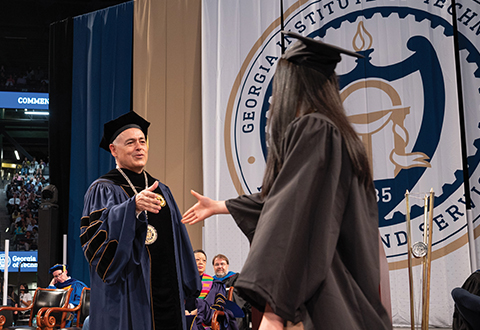 Georgia Tech, For Life
Georgia Tech’s newest college, the College of Lifetime Learning, might flip the question, Could you get in? and instead ask, What if Tech remained your trusted learning partner for life?
“Georgia Tech Infinity is the idea that Georgia Tech is a trusted learning partner across your lifetime,” says William Gaudelli, the inaugural dean and CEO of the College of Lifetime Learning.
Rather than limiting education to a four-year window, the college extends Tech’s reach and impact by building pathways for learners at pivotal moments across their lives and careers.“That might look like middle schoolers in summer STEM camps or a company offering access to our programs as an exit plan for a laid-off employee,” Gaudelli says. “We want everyone in the world to be a Georgia Tech learner.” One of the college’s goals is to engage 5 million learners by 2035 with different Lifetime Learning checkpoints.
To get to that milestone, the college is leaning heavily into technology with AI-based courses and learning materials. “Georgia Tech has always done scale and massification well,” Gaudelli says, pointing to the success of the Online Master’s Program. “We’re optimizing learning systems with homegrown AI tools like Jill Watson [Tech’s AI virtual teaching assistant, which last year outperformed ChatGPT in real-world educational settings, according to a study by Tech researchers] and preparing the workforce for an AI-driven future.” The college offers programs for learners, including alumni, to upskill and reskill at every stage of their careers. The door is open to any learner.
And for alumni who say they couldn’t get into Georgia Tech today, there’s some peace of mind knowing you’re in good company. “Many of us would not get in today. Be happy that we got in while we did!” jokes President Cabrera.
Special thanks to the Georgia Tech Data Visualization Lab—including Associate Professor Clio Andris, Assistant Professor Yalong Yang, Assistant Professor Cindy Xiong Bearfield, Associate Professor Alex Endert, Professor Duen Horng “Polo” Chau, and retired Emeritus Regents’ Professor John Stasko—for their contributions to the data visualizations featured in this story. Also special thanks to the Institutional Research & Planning Office.
Data Viz at Georgia TechThe Georgia Tech Data Visualization Lab is Tech’s hub for visualization research and innovation. Students learn to transform raw data into visualizations that make it clearer to analyze and to communicate information. Find more information about the group by visiting https://vis.gatech.edu.