Georgia Tech and the 1996 Centennial Olympics

Centennial Summer Olympic Exhibit

Relive the 1996 Olympic memories and explore their legacy at the opening of the Library's newest exhibit, "Centennial Summer: Georgia Tech's Olympic Legacy," showcasing the lasting impact of the 1996 Games through photographs, artifacts, and stories.

Join the opening on Saturday, February 28, from 10:00 a.m. to noon on the first floor of the Price Gilbert Memorial Library in the Scholars Event Theater.

Co-hosted by the Georgia Tech Library and Georgia Tech Alumni Association.

banner for an event
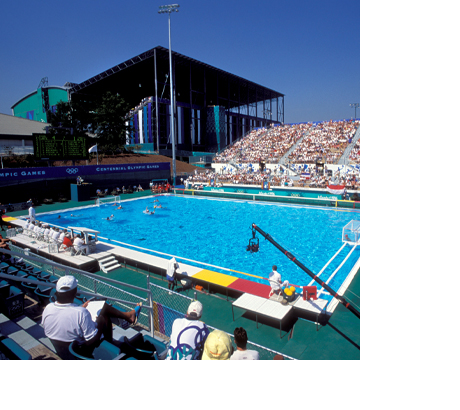
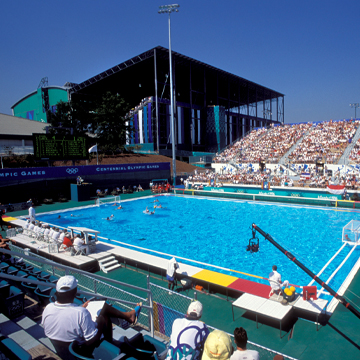
olympic pool 1996 in atlanta

Creating the Olympic Village

Watch how Georgia Tech’s campus underwent a massive transformation to become the Olympic Village, hosted Olympic and Paralympic events, and left Tech with massively improved residence halls for generations of students to come.

Our Olympic Legacy

By: Melissa Fralick


We will not be the same after 1996.

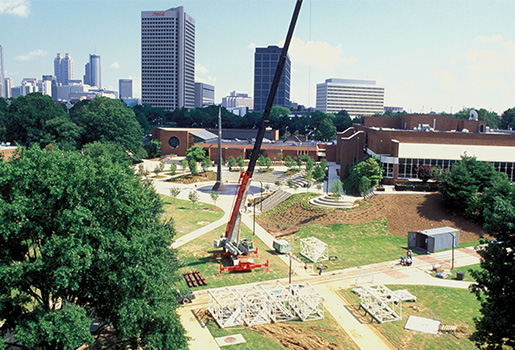
Landing the 1996 Olympics was a triumph for the city of Atlanta. For two weeks during that summer, all eyes were on Atlanta and Georgia Tech—home of the Olympic Village. It was a pivotal moment that amplified the gravitas of both the city and the university on the world’s stage. The Olympics indeed changed Georgia Tech forever. The campus expanded significantly to prepare for the games, with new athletic facilities, new residence halls and even new monuments built in just a few short years.

By the early 1990s, much of Atlanta’s urban core was overtaken by blight, Clough says. Georgia Tech was surrounded on all sides by rundown communities struggling with poverty, crime and addiction. The Olympics served as a catalyst for improvement, launching politicians and community leaders into action to improve the city before it would be in the world’s spotlight.

Tech’s involvement in the 1996 Olympic Games was initiated by Clough’s predecessor, John P. Crecine, who served as Tech’s president from 1987-1994.

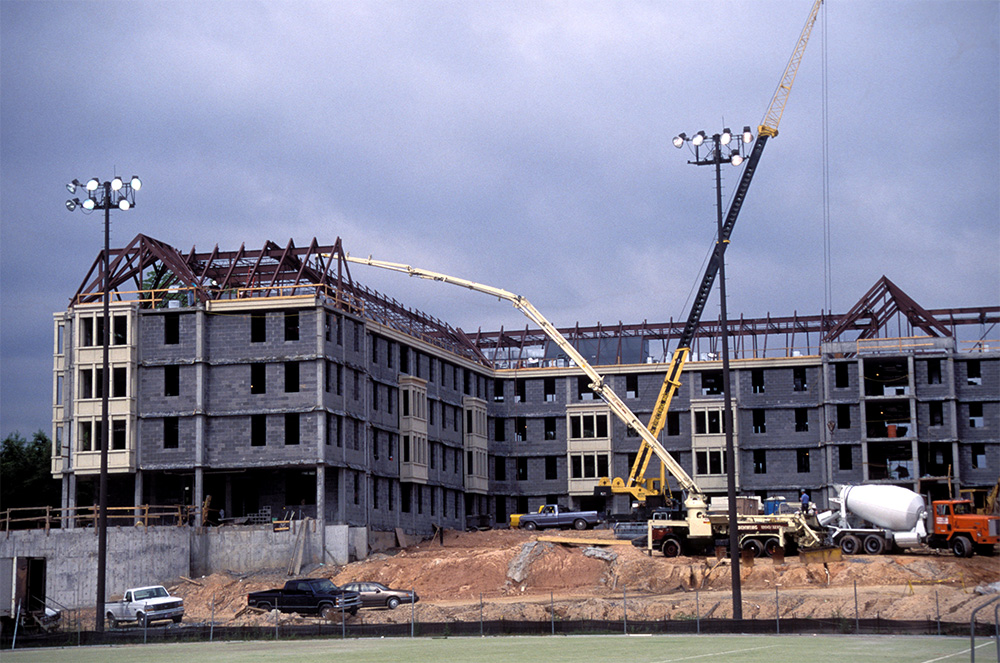
In 1994, Clough stepped in as president, inheriting a campus already under construction in preparation for the Olympics. At the time, Georgia Tech was the only single university ever to serve as the site of an Olympic Village. To house 15,000 elite athletes from 197 countries, Tech built seven large, apartment-style residence halls. This $108 million investment in new housing doubled Tech’s inventory, providing enough space to house 70 percent of the undergraduate student body on campus. 

Construction of Dorm on GT campus
In addition to hosting the Olympic Village, Tech was also the site of two Olympic athletic venues.

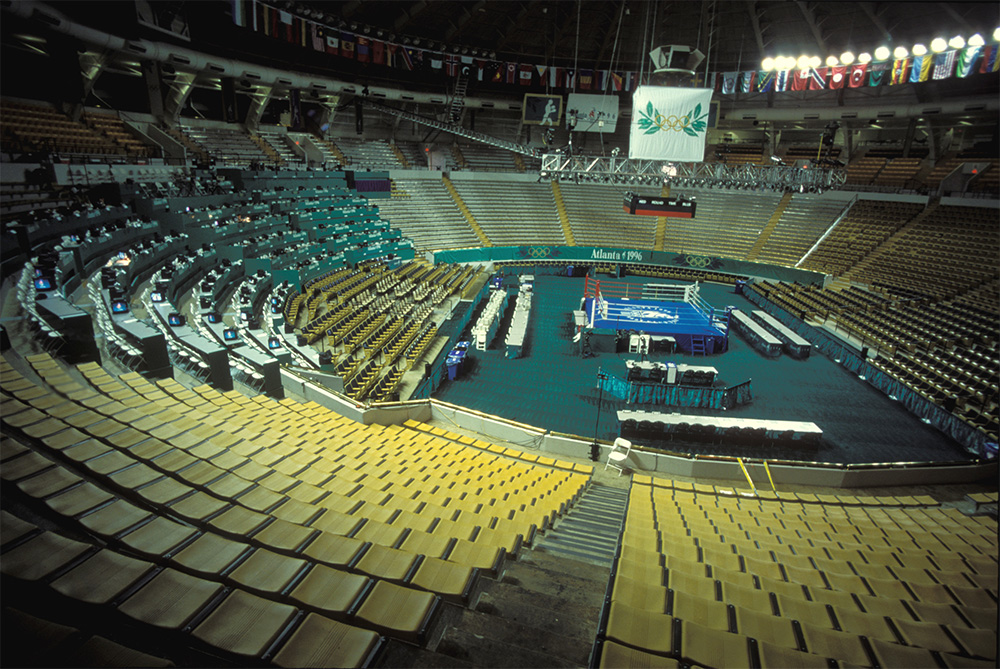
McCamish Pavilion, then known as Alexander Memorial Coliseum, got a $12 million overhaul to serve as the site of Olympic boxing and Paralympic volleyball. Meanwhile, $21 million dollars was invested into new aquatic facilities for swimming, diving, modern pentathlon, synchronized swimming and water polo.

Boxing Coliseum

After the Olympics, Tech enclosed the pool and incorporated it into the design of the Student Activity Center—now known as the Campus Recreation Center.

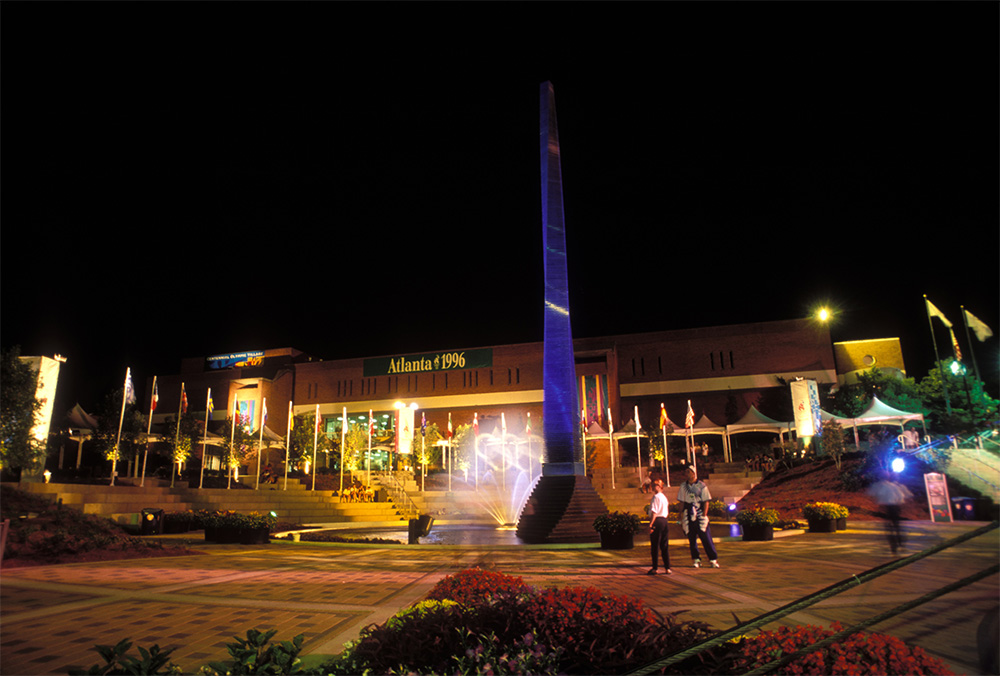
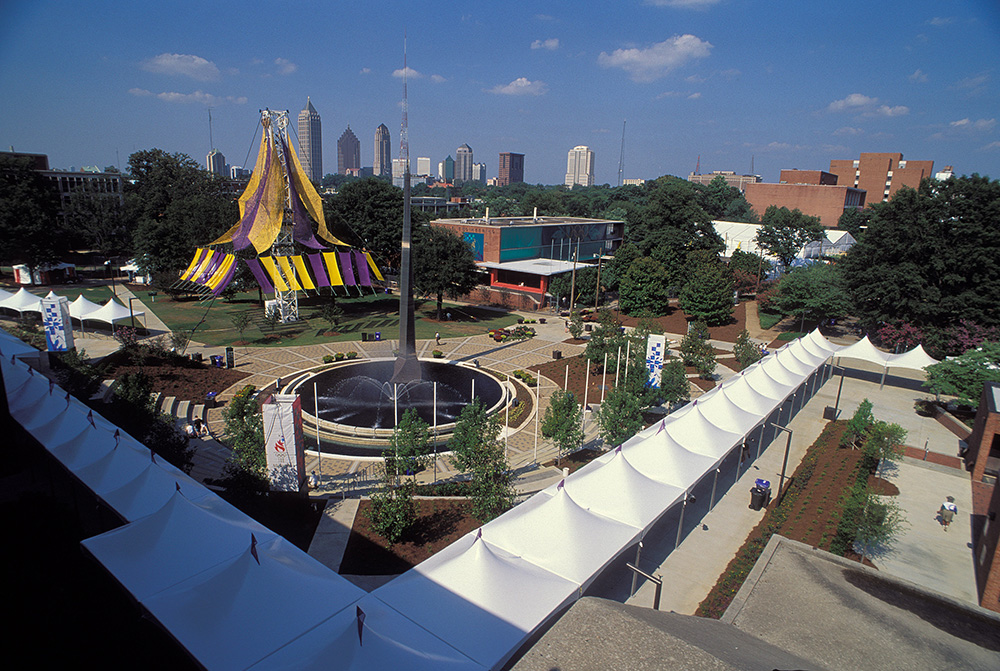
Tech also gained a new campus gathering place in preparation for the games. The Kessler Campanile, now one of Tech’s most iconic symbols, was originally built for the Olympics. The 80-foot, stainless steel obelisk rises from the center of a fountain surrounded by a plaza and amphitheater seating. The sculpture was donated by alumnus Richard Kessler, IE 68, MS IE 70, while the classes of 1943 and 1953 provided the funding to build the plaza.

Campanille Lighted during the 1996 Olympics
Though the Olympics lasted just 16 days, preparations on Georgia Tech’s campus took five years.

Bill Ray, Hon 07, was hired in 1991 to oversee Tech’s $221 million construction program. As vice president for Olympic planning, Ray was also charged with the logistical challenge of making sure life at Tech continued around the games.

As with any disruptive event, the Olympics were met with some ambivalence from students and faculty. Due to tight security, few students or faculty members were able to experience the Olympic Village after those years of preparation.

“Everybody on campus in the four to five years leading up to the Olympics experienced a significant inconvenience,” Ashley Gigandet Joseph, IA 94, says. “It felt like we were living in a construction zone.”

Ultimately, Clough believes the Olympics helped to move Tech toward its goal: defining the technical research university of the 21st century.

Georgia Tech’s Atlanta Olympians

Of the three individuals affiliated with Georgia Tech at the 1996 Olympics, all three received gold medals.

Jack Purdy, BA 22


Of Tech's 41 athletes and coaches who have participated in an Olympics, three represented the U.S. at the 1996 Games: Bobby Cremins as assistant coach of the USA Men's Basketball team, and Derrick Adkins, ME 93 and Derek Mills, EE 95, who both represented the U.S. in Track & Field. All three took home gold medals.

Derrick Adkins, ME 93 and Derek Mills, EE 95: Georgia Tech's Golden Sprinters

Adkins won gold in the 400m hurdles and Mills in the 4x400m relay, making it the third time a Jacket had won the 4x400m relay (Antonio McKay, IM 87, won it in 1984 & 1988).

Adkins and Mills qualified for the Olympics at the U.S. Olympic Trial meet, which was conveniently held at Centennial Olympic Stadium in Atlanta. Between training at the Griffin Track at Tech and competing at the Olympic Trials and the Olympics themselves, the pair did all of their relevant running within a three-mile radius. Mills even lived on campus during the Olympic Games.
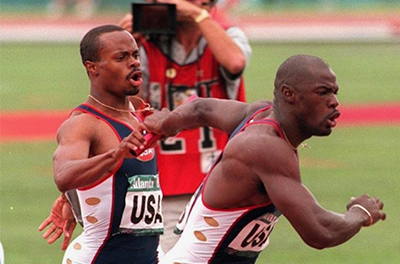
Derek Mills handing off baton

Mills (pictured left) handing off the baton during the 4x400m relay.  
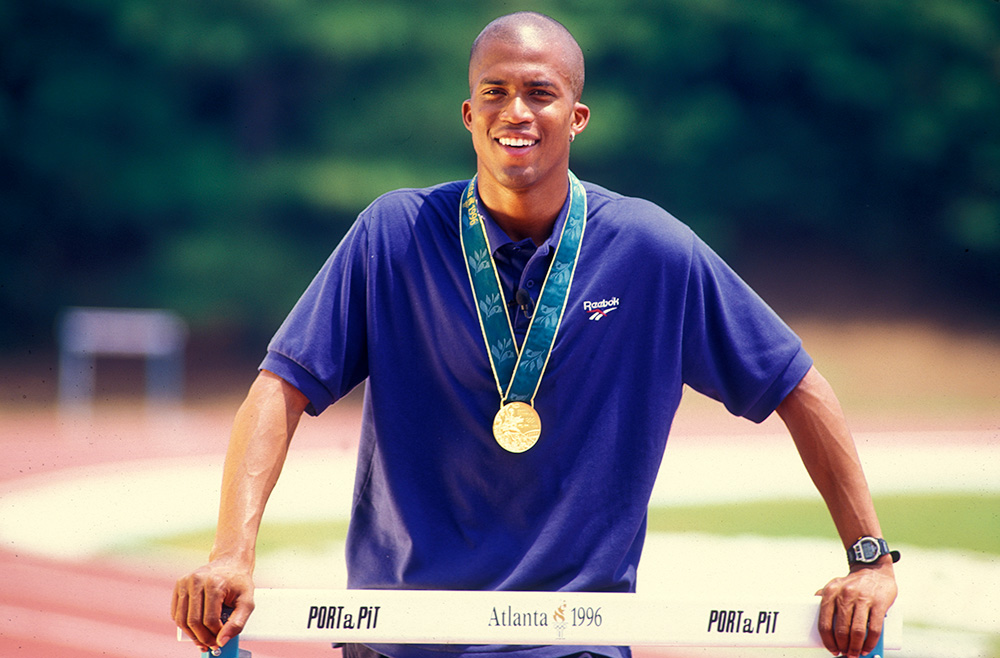
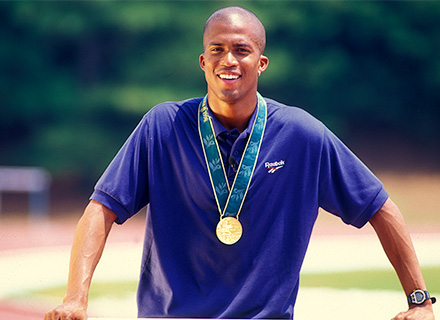
Derrick Adkins with gold medal

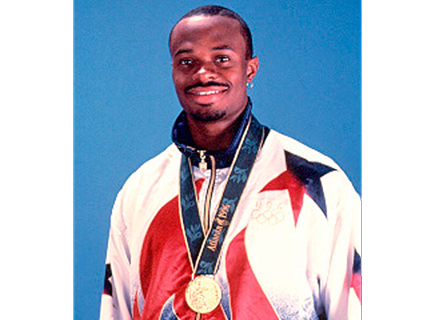
               Adkins with his gold medal. "I keep it in my apartment. It's                     tucked away," Adkins says.

"The games, for those two-and-a-half weeks was a surreal experience, especially because I was able to run well. It was like a dream. And then for several weeks thereafter, I was invited to speak on the Today show, and a lot of media wanted to speak to me," says Adkins, who ran the 400m hurdles in 47.54 seconds.
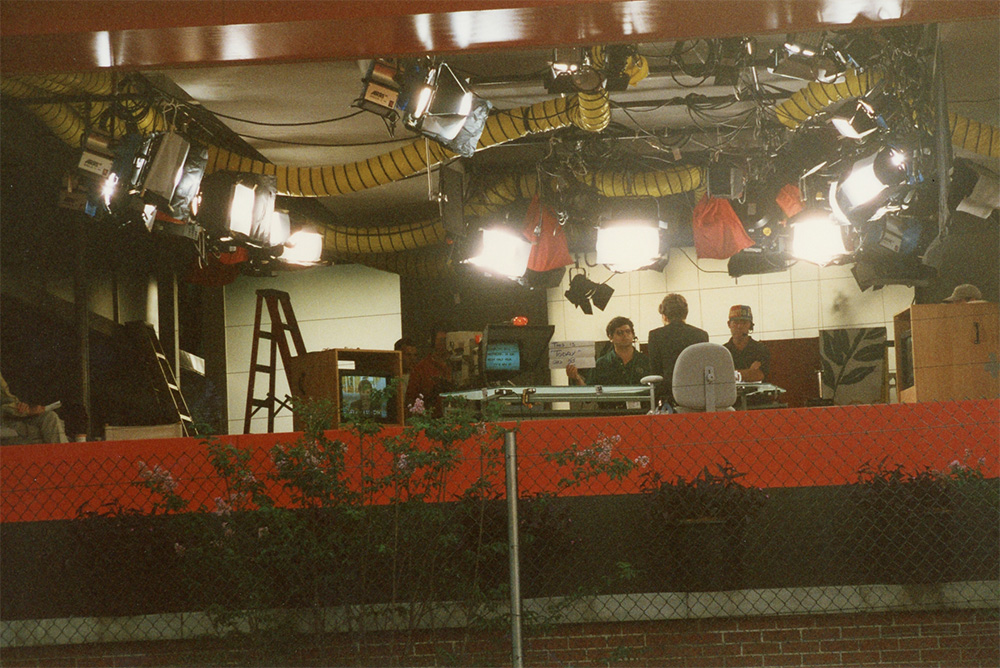
Today show studioThe Today show’s studio in front of the Campanile.
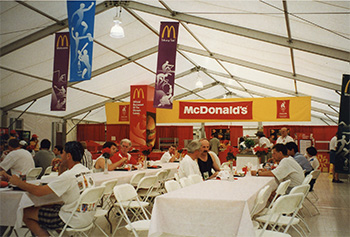
Macdonald's in the Olympic Village


Inside the Olympic Village, athletes had access to unlimited free McDonald’s with dishes from around the world. “It was pretty amazing. I think they put six or seven McDonald’s on campus,” remembers Mills.
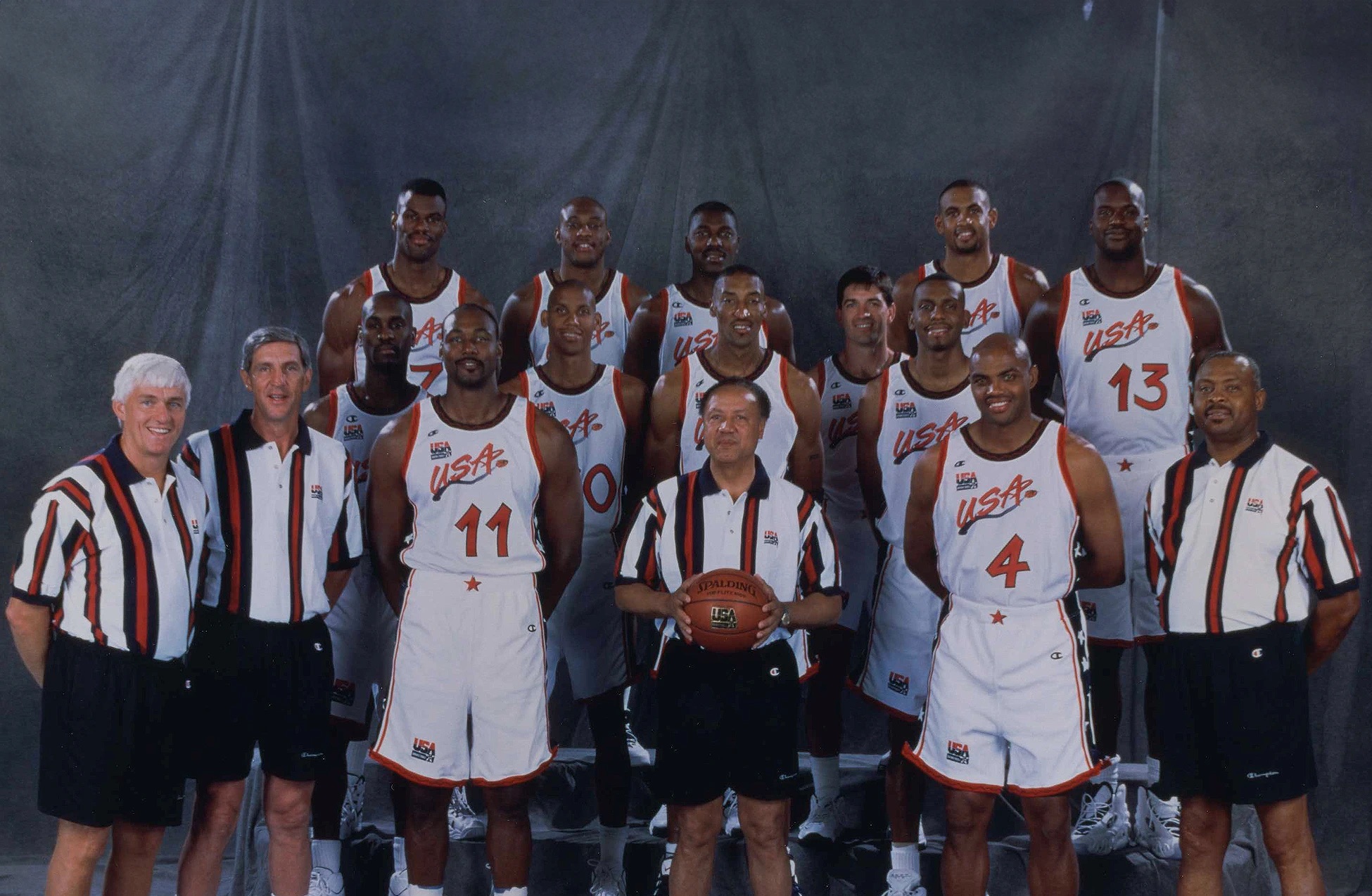


1996 USA Basketball Team The 1996 U.S. Men's Basketball team. Bobby Cremins on the far left. Photo courtesy USA Basketball

Coach Cremins' Olympic "Dream Team III"

Georgia Tech Basketball Coach Bobby Cremins reflects on serving as the assistant coach to the 1996 gold-medal U.S. Men's Basketball team.

By: Jack Purdy, BA 22


For the 1996 Olympics, the Team USA Men's Basketball coaching staff selected two prominent Atlanta basketball coaches: Lenny Wilkens from the Atlanta Hawks was named head coach and Georgia Tech's Bobby Cremins was selected as assistant coach. Cremins had just completed his 15th season as Tech's men's basketball coach.

Joined by assistant coaches Jerry Sloane and Clem Haskins, the coaching staff led one of the most dominant Olympic basketball teams ever built with 11 hall-of-famers.
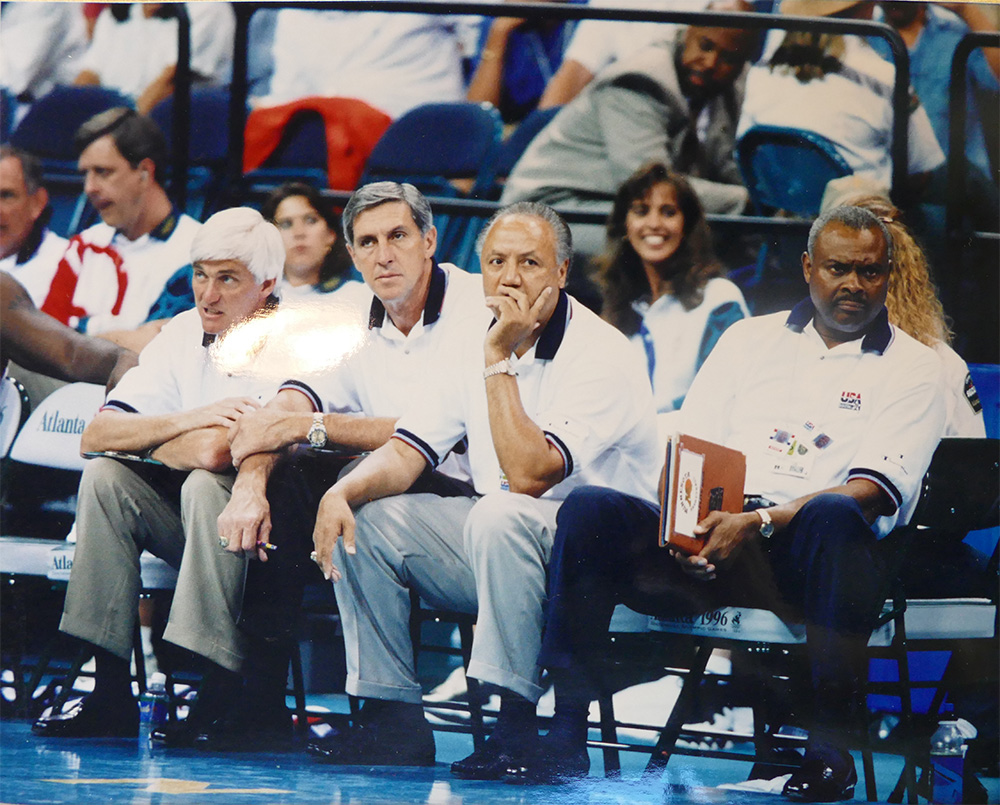
Coach cremins sitting on the bench with the rest of the coaching staff Cremins with the U.S. Men's Basketball coaching staff during a game during the 1996 Olympics.

Twenty years following the Olympics, Cremins was the 2016 recipient of the Honorary Alumnus designation from the Georgia Tech Alumni Association.

Q: When you return to campus, are there parts that give you flashbacks to the Olympics?

BC: When I see the Natatorium, I do think about it. They also did some nice renovations in the Alexander Memorial Coliseum (today, it's called the McCamish Pavilion). I was really pleased. It gave us a good upgrade. One of our biggest improvements was to the dorms. We fought for a few rooms, and those helped with our recruiting.

Q: How did you become an assistant coach for Team USA?

BC: What made it possible was my prior involvement with Team USA as a player and coach. I tried out for the 1972 Olympics. I was an assistant coach with Lute Olson at the 1986 Fédération Internationale de Basketball (FIBA) World Cup, which we won. Then, we qualified for the Olympics while I was head coach of the world qualifying team. When they called me, I was really surprised. It was such a great honor. I had to check with my boss, Dr. Homer Rice (then Georgia Tech's Director of Athletics), and my wife because it was such a long commitment.

Q: How did you split your time between coaching Georgia Tech and Team USA?

BC: Team USA didn't get together until three weeks before [the Games]. I stayed at my office at Georgia Tech until Coach Wilkens had a pre-meet in Chicago with the staff. That's when I shut down my Georgia Tech work. I turned it over to my assistant coach, Kevin Cantwell. I checked in every other day and, if there were any problems, they could call me. I wanted to give Coach Wilkens all I had.

Q: From a strategic perspective, how did you, Wilkens, and Sloane manage games knowing you were heavy favorites?

BC: We did not run a lot of set plays. Wilkens would say, "get it inside," "penetrate more." He let the players play as long as they didn't lose sight of what our goal was. Our mission was simply to win the gold medal and not to screw it up. We had to go through a few rounds where we were heavy favorites, and then it got serious in the semifinals, but we took care of business there.

In the finals against Yugoslavia, things got hairy. At halftime, we were only up five points, and that shook everyone up. In the second half, it got down to the nitty gritty, and Coach Wilkens made a brilliant move. We took Shaquille O'Neal out because he was having trouble guarding the other bigger players. We put David Robinson in at center, Scottie Pippen at power forward, and played three guards: John Stockton, Reggie Miller, and Mitch Richmond. Their quickness turned around that game.
Georgia Tech's Olympic Medalists

imgAltText

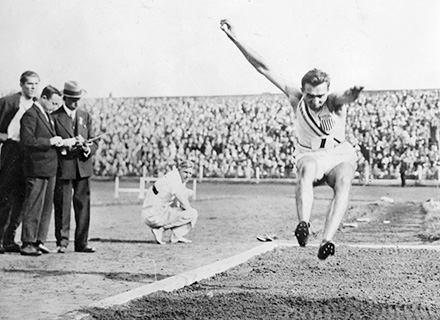
Ed Hamm, Commerce 1931

Tech’s first medalist, Ed Hamm, won the long jump at the 1928 Amsterdam Olympics. 

imgAltText

Antonio McKay, IM 87

McKay is Tech’s first Olympian to win multiple medals at the same Olympics, earning bronze in the 400m and gold in the 4x400m relay at the 1984 Los Angeles Olympics.
imgAltText

Derek Adkins, ME 93

Adkins took the 400m hurdles gold medal in Atlanta with a time of 47.54 seconds. 

imgAltText

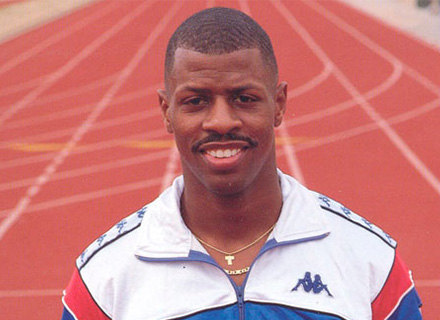
Derek Mills, EE 95

Mills ran on the USA 4x400 relay team in Atlanta, winning gold over Great Britain and Jamaica. 

imgAltText

Bobby Cremins

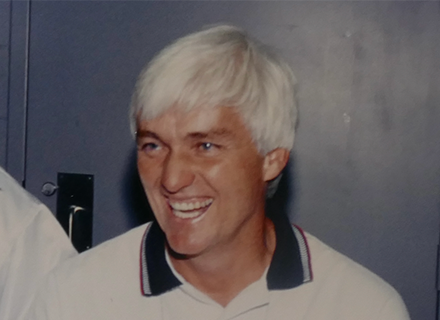
Assistant to the gold-medal winning U.S. Men’s Basketball team in 1996, Cremins is the only Georgia Tech coach to help lead a medal-winning team while actively coaching at Tech. 

imgAltText

Nell Fortner

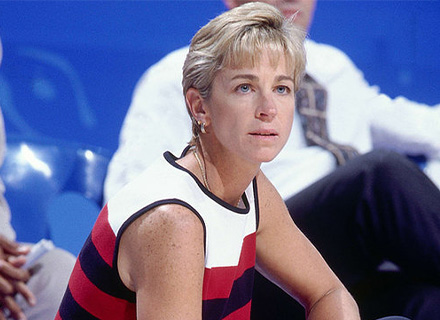
Before coming to Tech to coach Women’s Basketball, Nell Fortner led the U.S. Women’s Basketball to gold at the 2000 Sydney Olympics.
imgAltText

Stephon Marbury, Cls 00

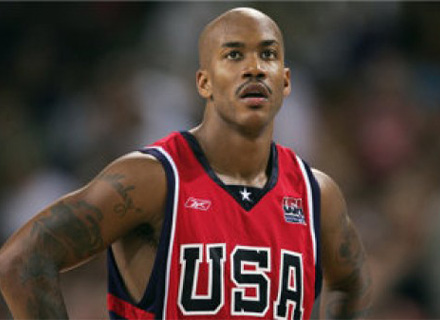
Four years after getting drafted to the NBA, Marbury won bronze with the U.S. Men’s Basketball team at the 2004 Athens Olympics. 

imgAltText

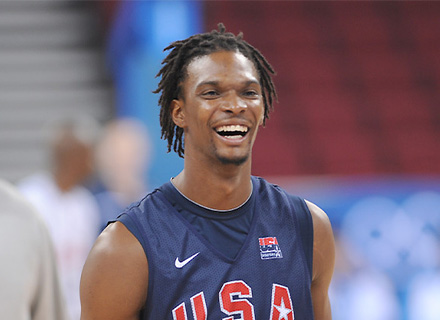
Chris Bosh, Cls 06

Part of the “Redeem Team,” Bosh helped bring gold back for the U.S Men’s Basketball team at the 2008 Beijing Olympics. 

imgAltText

Matt Kuchar, Mgt 00

Kuchar won the bronze medal in the first Olympic golf event in over 100 years at the 2016 Rio Olympics. 

imgAltText

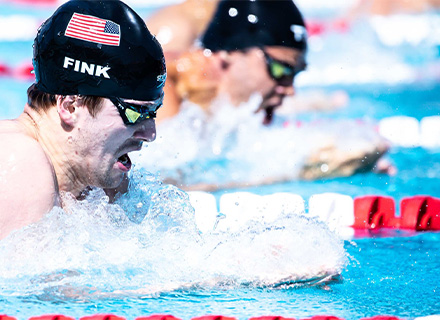
Nic Fink, MS ECE 22

After getting his master’s at Tech, Fink tied for silver with Britain’s Adam Peaty in the 100 breaststroke at the 2024 Paris Olympics. (Photo courtesy Jack Spitser) 

imgAltText

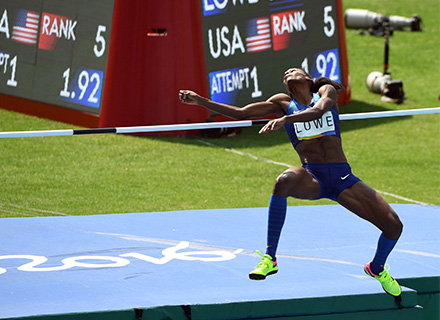
Chaunte Lowe, Econ 08

Lowe won bronze in high jump at the 2008 Beijing Olympics, becoming Tech’s first field athlete to win a medal in 80 years. 

imgAltText

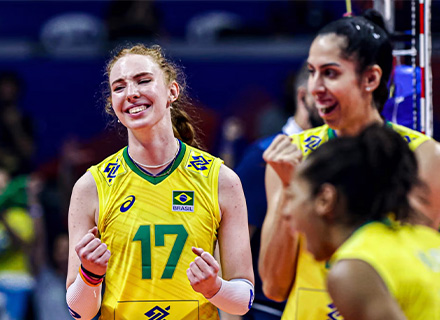
Julia Bergmann, ALIS 23

Tech’s first volleyball Olympian, Bergmann won gold with Brazil at the 2024 Paris Olympics.

The Kind of Grit That Can't Be Stopped

By: Tony Rehagen


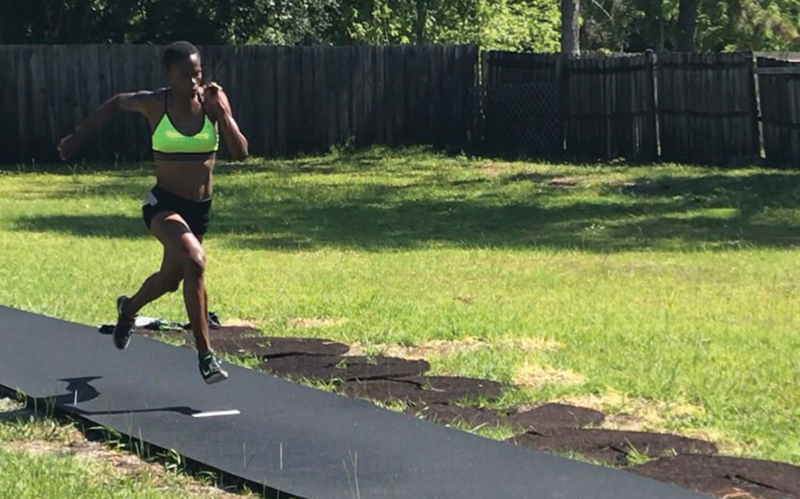
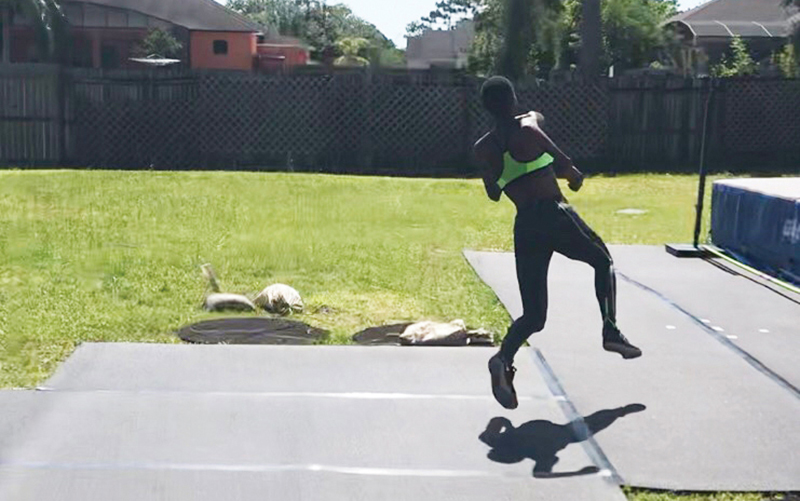
This Spring, Chaunte Lowe started a new home improvement project. She went to The Home Depot, bought some plywood, wall brackets, and rubber, and took to the backyard of her Florida house. She wasn’t building the floor of a clubhouse for one of her three children or a crude patio for herself. Lowe was putting together a makeshift approach for her high-jump gear so she could train while in lockdown.

For Lowe, making the U.S. Olympic Team bound for Japan is about much more than fulfilling her own professional ambition. In fact, after tying for seventh in the 2017 national championships, Lowe says she was all but done with track and field. But then, in August 2018, Lowe found a lump the size of a grain of rice on her breast. Eventually doctors diagnosed it as an early stage of an aggressive form of cancer. Six rounds of chemotherapy and a double mastectomy left Lowe cancer-free. That’s when the surgeon performing her reconstructive surgery urged her to aim for a fifth Olympiad. “He told me that people don’t realize how many young, skinny, and fit people he sees with cancer,” says Lowe. “He said, ‘If you go to the Olympics, your story is going to save lives.

Lowe practicing at homeLowe’s story began at Georgia Tech in 2002. She had come all the way from Riverside, Calif., to not only pursue a track career but also to challenge herself in the classroom. “Before students even get there, they’ve made the decision to come to Tech knowing the academics are going to be challenging while trying to compete at the NCAA Division I level,” says Alan Drosky, women’s track and field head coach for the Yellow Jackets. “A lot of young people have ambition to be excellent in everything. But Chaunte’s drive to actually reach her goals is not common at all.”
That competitive fire enabled Lowe to keep her grades up while excelling on the track. At the collegiate level, that meant helping the team in any way possible. Even on an ACC Championship Team, Lowe would score in the long jump, hurdles, and triple jump. “She even wanted to run the anchor leg of the relay race if we’d let her,” says Drosky. “She wanted to line up in every event we would put her in.”

Meanwhile, on an international level, Lowe focuses her energies on the high jump. And with the guidance of world-renowned high jumper and Georgia Tech jumps coach Nat Page, she would become a world champion and American record holder (which she set a mere 10 months after giving birth to her second child). But Olympic glory was a bit harder to come by. Lowe says she had worked so hard to make her first Olympic team in 2004 that by the time the then-sophomore got to Athens, she was overwhelmed by the actual competition. She finished a disappointing sixth in both 2008 Beijing and 2012 London. Four years later in Rio, she knocked the bar off with the heel of her foot on her last jump and barely missed the podium, coming in fourth.

Finally, in 2017, the International Olympic Committee announced that, after reviewing samples from drug tests taken prior to the Beijing games, three athletes had tested positive for banned substances. The three were disqualified, lifting Lowe into third place. She flew to Los Angeles with her family and Coach Page to receive her bronze medal that November. Less than a year later, she had cancer.

chaunte practicing at homeLowe doesn’t pretend that the diagnosis didn’t frighten her. But she says she reacted the only way she knew how—the way she had learned in college. She did her research, made a plan, put together the best team of doctors, and put herself in the best position to overcome the disease. After doing all that, making a fifth Olympics might not seem as impossible as it once had.

“It’s not going to be easy,” says Page, her old coach. “But she knows she can go through it; she’s done it before. And going through breast cancer might have given her a sense of what she’s really capable of. If there’s anybody that can do it, it’s her. I won’t ever doubt her.”

Page even thinks that the yearlong delay for the Tokyo games might help Lowe by giving her extra time to prepare herself and get back to full strength—if she can just find a way to train. Because of her chemotherapy, Lowe’s immune system is compromised, making her at a higher risk of developing Covid-19.

So she has acquired some weights and workout equipment for home workouts. And, of course, she’s building her own high jump in the backyard. Here, she’ll train, take care of her family, and prepare as best she can to tackle any and all challenges that might await.

“There was something about the fight I learned at Georgia Tech,” says Lowe. “You don’t crumple and cry. You find a way to get it done. You find a way to win.”

Georgia Tech Olympians & Coaches

List is ordered by earliest Olympic appearance. *indicates coaches.

Homer Whelchel, TE 1924, (USA): Men’s Field, 1924 Paris 
Ed Hamm, Com 1930, (USA): Men’s Track, 1928 Amsterdam, Gold Medalist 
Antonio McKay, IM 87, (USA): Men’s Track, 1984 Los Angeles (Gold and Bronze Medalist), 1988 Seoul (Gold Medalist) 
Mark Smith, MS EE 79, PhD EE 84, (USA): Men’s Fencing, 1984 Los Angeles 
Jason Varitek, Mgt 95, (USA): Baseball, 1992 Barcelona 
Nomar Garciaparra, Cls 95, (USA): Baseball, 1992 Barcelona 
*Bobby Cremins (USA): Men’s Basketball, 1996 Atlanta, Gold Medalist 
Derrick Adkins, ME 93, (USA): Men’s Track, 1996 Atlanta, Gold Medalist 
Derek Mills, EE 95, (USA): Men’s Track, 1996 Atlanta, Gold Medalist 
Angelo Taylor, Cls 00, (USA): Men’s Track, 2000 Sydney (Gold Medalist), 2004 Athens, 2008 Beijing (Gold Medalist), 2012 London (Silver Medalist) 
*Nell Fortner (USA): Women’s Basketball, 2000 Sydney, Gold Medalist 
Vesna Stojanovska, AE 07, (Macedonia): Women’s Swimming, 2000 Sydney, 2004 Athens 
Jorge Oliver, ChE 03, (Puerto Rico): Men’s Swimming, 2004 Athens 
Leo Salinas, Econ 02, (Mexico): Men’s Swimming, 2004 Athens 
Onur Uras, IE 09, (Turkey): Men’s Swimming, 2004 Athens, 2008 Beijing 
Stephon Marbury, Cls 00, (USA): Men’s Basketball, 2004 Athens, Bronze Medalist 
Gal Nevo, Econ 10, (Israel): Men’s Swimming, 2008 Beijing, 2012 London, 2016 Rio 
Chris Bosh, Cls 06, (USA): Men’s Basketball, 2008 Beijing, Gold Medalist 

Jen Yee, MSE 10, (Canada): Softball, 2008 Beijing 
Caitlin Lever, Mgt 08, (Canada): Softball, 2008 Beijing 

Chaunte Lowe, Econ 08, (USA): Women’s Field, Bronze Medalist 


Iris Wang, ID 09, (China): Men’s Swimming, 2012 London 
Andrew Chetcuti, Bio 16, MBA 25, (Malta): Men’s Swimming, 2012 London, 2016 Rio, 2020 Tokyo 
Matt Kuchar, Mgt 00, (USA): Men’s Golf, 2016 Rio, Bronze Medalist 
Keren Siebner, IE 12, (Israel): Women’s Swimming, 2016 Rio 
Caio Pumputis, BA 22, (Brazil): Men’s Swimming, 2020 Tokyo (held in 2021) 
Defne Taçyildiz, current student (Turkey): Women’s Swimming, 2020 Tokyo (held in 2021) 
Baturalp Ünlü, CS 24, (Turkey): Men’s Swimming, 2020 Tokyo (held in 2021) 
Josh Okogie, Cls 20, (Nigeria): Men’s Basketball, 2020 Tokyo (held in 2021) 
Avi Koki Shafer, Cls 21, (Japan): Men’s Basketball, 2020 Tokyo (held in 2021) 
*Nat Page (USA): Track & Field, 2020 Tokyo (held in 2021) 
*Mfon Udofia (Nigeria): Men’s Basketball, 2020 Tokyo (held in 2021) 
Nic Fink, MS ECE 22, (USA): Men’s Swimming, 2020 Tokyo (held in 2021), 2024 Paris (Silver Medalist) 
Berke Saka, BA 25, (Turkey): Men’s Swimming, 2020 Tokyo (held in 2021), 2024 Paris 
Julia Bergmann, ALIS 23, (Brazil): Women’s Volleyball, 2024 Paris, Gold Medalist 
Chris Eubanks, Cls 18, (USA): Men’s Tennis, 2024 Paris 
Jose Alvarado, Cls 21 (Puerto Rico): Men’s Basketball, 2024 Paris 
Imane El Barodi, ME 23, MS ME 25, (Morocco): Women’s Swimming, 2024 Paris 
Ariana Dirkszwager, current student (Laos): Women’s Swimming, 2024 Paris 
Ela Naz Ozdemir, current student (Turkey): Women’s Swimming, 2024 Paris 
Giovana Reis, current student (Brazil): Women’s Swimming, 2024 Paris

How Tech Knowhow Helped Atlanta Land the Olympics

Atlanta’s bid to host the 1996 Olympic Games was viewed by many as a long shot.

And without Georgia Tech, the city’s improbable victory likely wouldn’t have happened. A coalition of Tech faculty and students created a dazzling virtual tour for Atlanta’s Olympic bid that wowed the International Olympic Committee and helped secure the city’s selection as the site of the 1996 Summer Olympics.

In 1989, Billy Payne, who led Atlanta’s Olympic charge, approached then-Georgia Tech President John P. Crecine for help with the Olympic bid. Payne wanted the Institute to create a 3-D architectural model of the city of Atlanta. But Crecine had something different in mind. “Pat Crecine being a technologist said ‘no, no, we can do something much better than that,’” recalls Ed Price, project manager for federal research partnerships at Tech’s Institute for People and Technology.

In 1989, terms like ‘virtual reality’ and ‘computer animation’ were relatively unknown. Crecine wanted to use this kind of emerging technology to give Atlanta an edge and recruited Tech’s faculty and students to help make it a reality. Among those who raised their hands for the effort were Price and Scott Robertson, associate director of Tech’s Interactive Media Technology Center, both of whom were undergraduates in 1989.

“For the next year, we worked to build the initial system to showcase how Atlanta would prepare for the games,” Price says.

The interactive presentation they created allowed a viewer to “fly” into Atlanta from above and, using a trackball, navigate the city as well as computer renderings of facilities that would be built for the Olympics. To accomplish this feat, the team blended helicopter footage of Atlanta with topographic data, computer graphics, and even a computer-animated runner carrying the Olympic torch into the future stadium.

“This was early experimentation in photogrammetry for visual effects,” Robertson says. “It was the first time someone had done such a detailed, and for the time, realistic, depiction of an animated human.”

“We used all of our computers, all of Georgia State’s, and other people’s, even, because there was so much computer processing to do,” Price says. “And that was before we had high-speed Internet connectivity.” In true Georgia Tech fashion, they engineered their way past any roadblocks to make their vision a reality. “A lot of these techniques had not really been developed. They were developing new ways of doing things. We came up with solutions to solve problems along the way,” Robertson says. 

The final iteration of the system featured an animated map of campus back-projected onto a frosted Lucite model. This served as a sort of touch screen controller. Touching points on the Lucite map would drive the location viewed on the screens. This huge feat wasn’t accomplished in a silo. Price and Robertson recall how willing businesses and organizations were to pitch in. For example, Delta Airline’s machine shop assisted with the Lucite model. A local company gave them free use of their editing equipment. And people from Georgia State wrote the scripts and managed production of video for the final presentation that was delivered to the International Olympic Committee in Tokyo in 1990.

“It really was a citywide effort,” Price says.

All of this work was important to combat lingering stereotypes of the South and give credibility to the city of Atlanta, which was relatively unknown to much of the international community. The effort paid off. The IOC was blown away, and many believe that Tech’s innovative presentation was what pushed Atlanta over the edge. Shortly after Atlanta was announced as the host for the '96 Olympics, Andrew Young, a former U.N. Ambassador and the co-chair of the Atlanta Committee for the Olympic Games, praised Tech’s contribution to the successful bid.

“We had high-tech Southern hospitality,” Young said.