Major Change: Nearly Half of Georgia Tech Students In A Given Grad Year Change Their Major
By: Jennifer Herseim, M-Train photo by Tyler Ward | Categories: Featured Stories
By: Jennifer Herseim, M-Train photo by Tyler Ward | Categories: Featured Stories
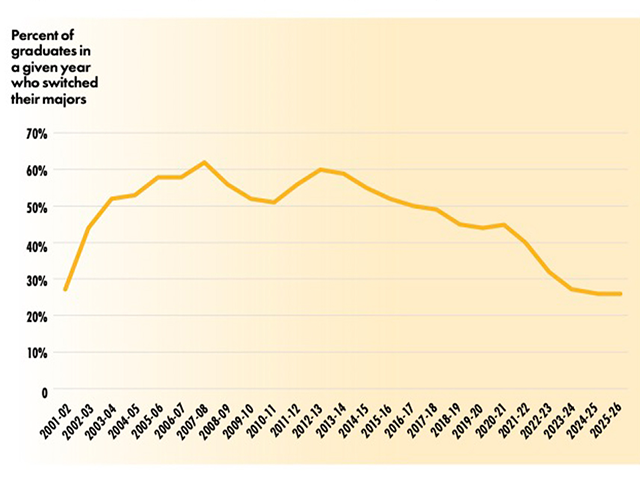
Across higher education, changing majors is more common than you might think, and Georgia Tech students are no exception. From 2001 to 2026, on average 47% of Tech graduates in a given graduation year switched degrees at least once during their time at Tech.
“Changing majors is a common phenomenon among undergraduate students and Georgia Tech is in line with national trends,” notes Georgia Tech’s Registrar Reta Pikowsky.
About 30% of U.S. undergraduates change their majors at least once, according to the National Center for Educational Statistics. A study from the National Student Clearinghouse estimates it’s closer to 44%.
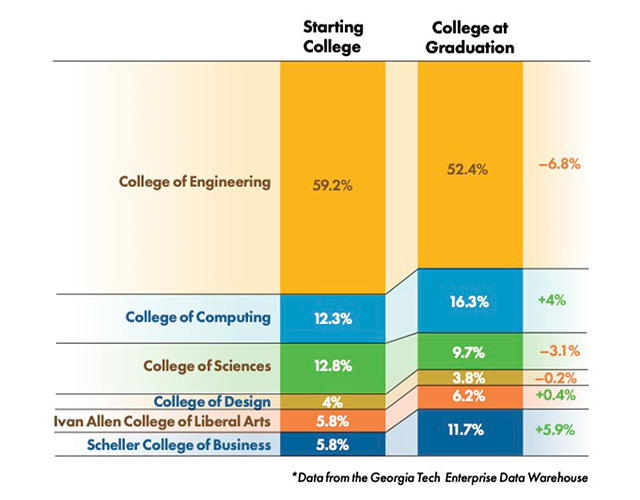
The Institute tracks the migration of students within a college and outside of their college. According to data collected from Tech’s Enterprise Data Warehouse, a greater share of students who were in the College of Engineering when they were admitted changed majors within their college (16.6%) than students who switched majors within the College of Design (1.5%), College of Computing (0.15%), College of Sciences (2.16%), Ivan Allen College of Liberal Arts (1.32%), and the Scheller College of Business (0.62%).
A student who declared mechanical engineering when they started at Tech might realize they’re more fit for industrial and systems engineering. Still, a computer engineering student might discover they’re more interested in software than hardware and make a bigger change from the College of Engineering to the College of Computing.
Changing majors typically happens between sophomore and junior year, when classes become more specialized and start to resemble the work a student might be doing after graduation. “They might get into the preparatory courses for their major and they’re no longer enthused or realize this isn’t what they thought it would be,” Pikowsky says.
The job market can also drive demand for certain programs. For example, over the last decade, Pikowsky has seen more students switch into computer science.
In the last five years, students at Tech have been less likely to switch majors compared to historical trends. Of the 2025–’26 graduation year, only 26% changed programs. That might be caused by a level of uncertainty, Pikowsky says. Students are waiting to see how emerging technologies, such as AI, will affect the job market.
Many students also find that a minor can add value to their degrees without having to switch their major, Pikowsky says. “We have certificates and minors that might help a student in their job search efforts but won’t slow down a student in terms of their time to graduation,” she says.
When a student wants to change majors, both the outgoing school and the incoming school must sign off on the transfer. Students can be denied if they don’t have the grades in prerequisite courses, but that’s rare, Pikowsky says.
“Generally, we want to keep the change-of-major process as open as we can because we want students to have options and be able to find what they want to do and what they want to study,” Pikowsky says.
Students switch for a variety of reasons, but changing majors for an “easier” path is a myth, Pikowsky says. “When someone asks me what the easy majors at Tech are, I say with all honesty and sincerity, we don’t have any easy majors here,” she says.
“What has impressed me over the course of my 21 years at Tech is the fact that if you graduate from Georgia Tech in whatever major we offer, you’re graduating with a skillset that employers want and need,” Pikowsky says.
Regardless of the degree you receive, a diploma from Georgia Tech can open doors, says Clint Bailey, TE 97. “Your major doesn’t lock you in for life.”
Georgia Tech students across majors learn critical thinking, adaptability, and problem solving—skills that translate across industries. “Employers are increasingly hiring based on competency and aptitude rather than exact majors or ‘perfect’ credentials,” he says.
If you’re thinking of a career change outside of your degree, Bailey advises maintaining and growing your Tech network. He also cautions against chasing a new job purely for a better salary. “You need to make sure you’re switching for the right reasons. It needs to align with your career goals and skills and passion.”
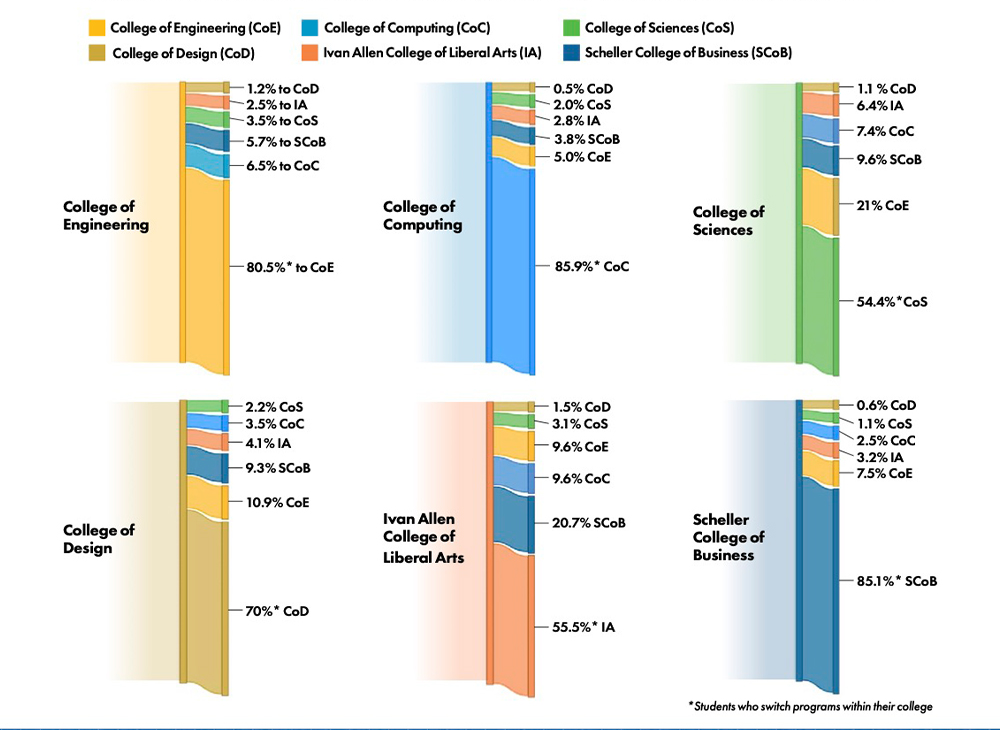 Data collected from the Georgia Tech Enterprise Data Warehouse 2001-2026 Students Migration Report
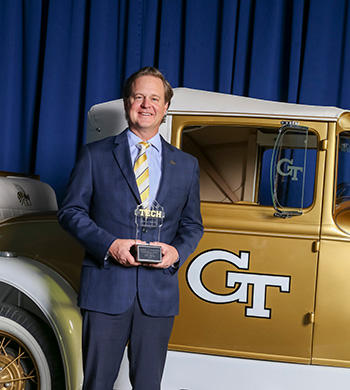 Clint Bailey, TE 97, was working in a textiles plant in South Carolina after graduation, doing exactly what he was meant to do with a textile engineering degree. He received a call from another recent Tech grad with an interesting proposition: Quit and come do recruiting.
He initially turned him down—“I didn’t take six calculus courses to be a recruiter,” he remembers thinking. But he always thought of himself as a “business engineer,” someone who could navigate the corporate world with the technical background of an engineer. So he decided to leave the production line. A year later, he and two fellow Tech grads started their own company, HUNTER Technical. Over the next 23 years, they helped thousands of engineers find meaningful work. The company was acquired in 2021, and Bailey went on to lead TechBridge as its CEO, making the transition this year to board chair.
“I was a first-generation college student, so I didn’t have that traditional expectation that this is your major and this is your destiny,” he says. “I felt like my skills and experience mattered more than necessarily the degree itself.”

By the time Brandon “Swaff” Swafford, ID 07, filled out a change-of-major form at Georgia Tech, he’d already pondered a question haunting generations of Jackets: stay on the current track, or switch to something that’s a better fit? Something like the “M-Train.”
Twenty years ago, that was a Georgia Tech student’s favorite escape hatch: a smooth transition from pitiless engineering exams into a friendlier management degree.
Swafford began as a computer science major, but it didn’t take him long to realize programming wasn’t for him.
“The problem wasn’t Tech—it was me,” he says. “I quickly realized CS was more about coding, less about creativity. I didn’t want to be a programmer.”
He was a guitar player, a songwriter, the kind of guy who’d disappear for 24 hours to teach himself video editing just to land a joke. Friends in the School of Architecture suggested industrial design. By Spring 2007, he graduated with that degree, and a head full of riffs that led him straight into a recording studio job.
Along the way, Swaff co-created some campus folklore. “The M-Train” was a running joke among would-be engineers—if you can’t hack calculus and circuits, you could always try management. “But the reality is, it’s not easy,” Swafford says of the Scheller College of Business. “Still, it was fun to poke at.”
Eventually, the joke became a song. During a dead-week Bible study, Swafford and Theta Xi brother Daniel Baily, IE 08, MS HS 09, aka DBay, “started making up these lyrics on the spot, just messing around,” Swafford recalls.
Out came “M-Train,” a rapid-fire hip-hop ode to changing majors, built around a fictional homeless character—a former student who tells a younger student, “If you stick with what you got, you’re gonna end up just like me,” and, “Why would you take the harder route when there’s an easy way?”
Swaff and DBay first performed it a cappella at a Theta Xi meeting, and it detonated. A year later, they recorded the song and shot a video—using library equipment and student “actors” who answered a Facebook invite.
The video debuted on YouTube, and the calls started coming. Tech’s athletic department tapped them for a football video and song celebrating new coach Paul Johnson—that one landed on TV sports networks, leading to more gigs.
“The ‘M-Train’ opened some musical doors for us, but the funny thing is, Daniel and I weren’t even really a band—we were just buddies,” Swafford says.
Now 42, splitting time between music production and real estate in Villa Rica, Georgia, Swafford is rebuilding a studio. He has two young daughters with a third on the way.
“My girls request the ‘M-Train’ and GTG stuff when we’re in the car, which is hilarious,” he says. “I think the song still works as a song for all Georgia Tech students, no matter their major.” —Jerry Grillo