Tech’s Fanning Student-Athlete Performance Center Opens
By: Jennifer Herseim, Photos Courtesy of Georgia Tech Athletics | Categories: Featured Stories
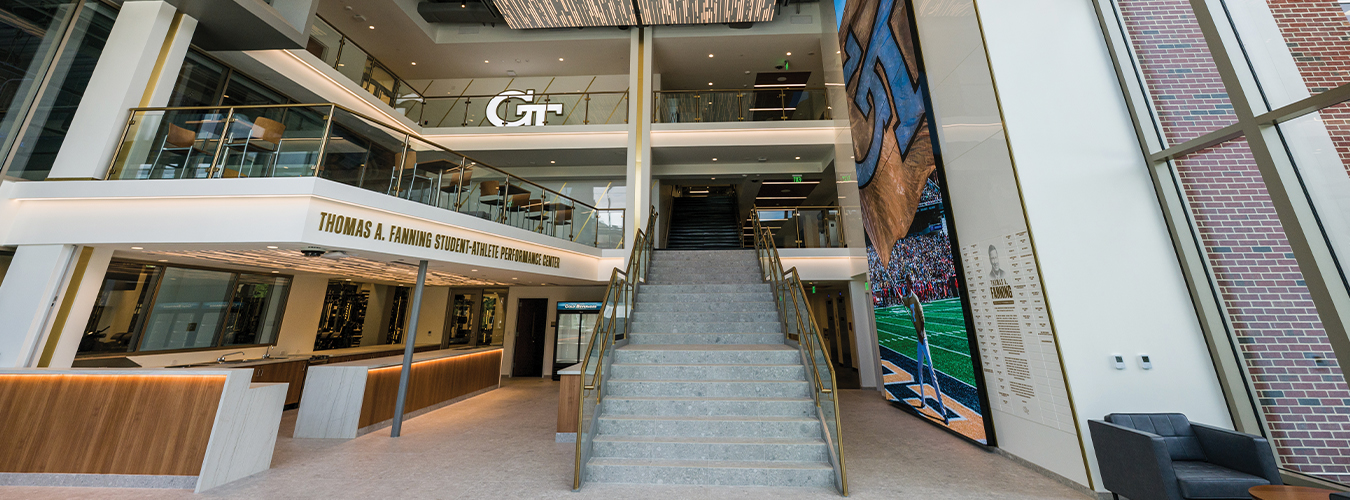
With motion-capture cameras to analyze movement and force plates that can track weight distribution, the new Thomas A. Fanning Student-Athlete Performance Center brings a higher level of training, performance analysis, and recovery to Tech’s student-athletes.
“They have the best of the best,” says Heather Taylor, CE 15, DPR Construction’s project manager for the build. “Whether it’s recovering from an injury or optimizing performance, they can get the data they need to analyze how to jump higher, run faster, or perform a technique correctly.”
Space For Recovery Designed by Alumni
 The four-story building includes 100,000 square feet devoted to nutrition, training, recovery, and office space for Georgia Tech Athletics. The design was by S/L/A/M Collaborative (SLAM). The building is dedicated to Thomas A. Fanning, IM 79, MS IM 80, HON PhD 13, executive and former CEO of the Southern Company.
The recovery floor with above-gound hydrotherapy pools is alumna Sarah Rohlfsen’s favorite part of the new building. Rohlfsen, EnvE 22, who served as a project engineer on the construction team, remembers the buzz around plans for the performance center while she was a student-athlete on the Goldrush dance team. She started working on the project soon after joining DPR in 2022.
“I’m grateful for my time at Tech and how it shaped me as an athlete here. It’s great that my impact at
Tech didn’t stop when I got my degree,” Rohlfsen says.
First Sports Science Lab
 The center includes Tech’s first sports science lab, in partnership with Emory Healthcare. The lab has ceiling- and wall-mounted cameras to analyze athletes’ motion and advanced equipment, including a split-belt treadmill with gait analysis. Force plates in the floor measure weight distribution from three different capture zones.
The strength and conditioning areas include 32 fully equipped racks with camera-based velocity tracking, which can give athletes real-time feedback.
Engineering Feats
Building the support for the hydrotherapy pools was a challenge, Rohlfsen says. “We had to account for the weight with a steel structure but also build tall concrete pads on the mezzanine level to support where those pools sit,” she says.
Building onto a college football stadium that’s the oldest one in the country continuously in use came with its share of unforeseen conditions. For one, existing studies on the rock depth were outdated, forcing crews to pivot to keep on schedule.
As alumni, Rohlfsen and Taylor were familiar with campus life and able to explain to their teams some of Tech’s campus traditions.
“The rest of our team sort of freaked out the first time the whistle blew,” Taylor says. “We told them they’d get used to it.”