Economic Powerhouse: The Institute Contributes $5.8 Billion in Economic Output
| Categories: Alumni Interest

Georgia Tech generated a whopping $5.8 billion for the state of Georgia in the last fiscal year, according to the latest economic impact report released by the University System of Georgia. See how Tech’s economic impact stacks up.
No. 1 Contributor
Georgia Tech accounted for one-quarter of the total $23 billion output generated by the USG’s 26 institutions in fiscal year 2024.
| Institution | Economic Contribution |
| Georgia Institute of Technology | $5,824,634,813 |
| University of Georgia | $3,732,195,148 |
| Georgia State University | $3,222,134,120 |
| Kennesaw State University | $2,301,836,786 |
| Augusta University | $1,614,690,914 |
| Georgia Southern University | $1,167,294,177 |
| University of North Georgia | $768,228,096 |
| University of West Georgia | $654,416,321 |
| Georgia Gwinnett College | $558,192,263 |
| Valdosta State University | $385,314,224 |
| Georgia College & State University | $333,714,364 |
| Middle Georgia State University | $312,179,178 |
| Columbus State University | $301,351,222 |
| Clayton State University | $292,531,077 |
| Albany State University | $282,164,316 |
| Fort Valley State University | $179,536,777 |
| Georgia Highlands College | $167,435,508 |
| Savannah State University | $164,403,823 |
| Dalton State College | $149,136,574 |
| Abraham Baldwin Agricultural College | $128,195,503 |
| Gordon State College | $125,439,845 |
| Georgia Southwestern State University | $115,390,420 |
| College of Coastal Georgia | $107,657,507 |
| Atlanta Metropolitan State College | $76,111,900 |
| South Georgia State College | $64,624,078 |
| East Georgia State College | 55,506,908 |
| Total | $23,084,315,862 |
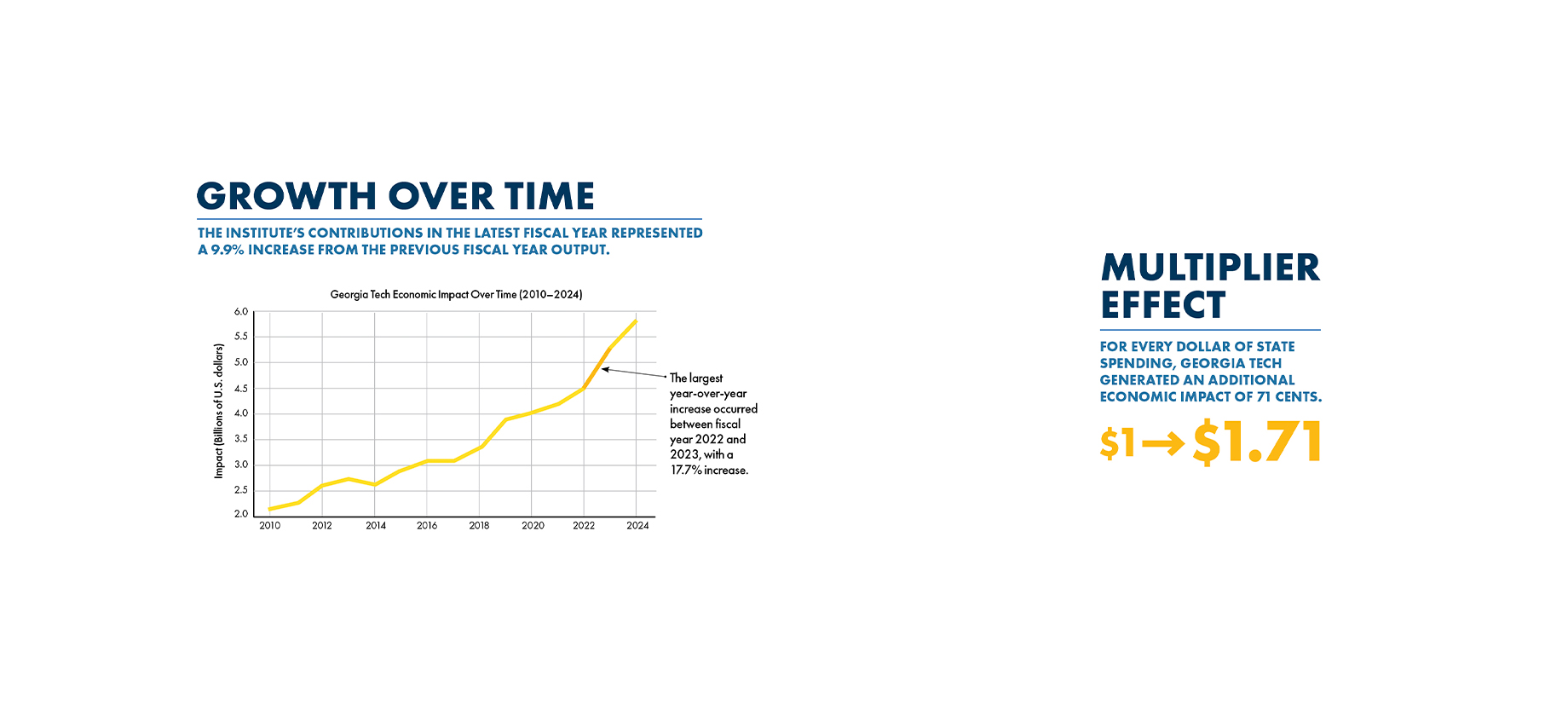
Growth Over Time
The Institute’s contributions in the latest fiscal year represented a 9.9% increase from the previous fiscal year output.
Top Poultry Producer
Georgia is the largest producer of poultry in the country. It’s one of the five “P’s” or key agricultural products: Peaches, Peanuts, Pine Trees, Poultry, and Pecans. Read about one way Tech is keeping Georgia’s poultry industry on top.
For the Birds
A smart robotic cutting arm developed by Georgia Tech’s Agricultural Technology Research Program could power up the state’s vital poultry industry.
By Kristin Baird Rattini
For more than 50 years, Georgia Tech’s Agricultural Technology Research Program (ATRP) has been driving transformational innovation in the state’s poultry industry, the largest in the country and eighth largest in the world.
The industry produces more than 30 million pounds of chicken on an average day and generated more than $41 billion in economic activity in the state in 2024. A new intelligent cutting system designed by a team of Georgia Tech researchers assembled by the ATRP is poised to boost both of those numbers and advance meat processing operations through a combination of 3D imaging, AI, and robotics.
This cutting-edge intervention is aimed at the most skilled task in a poultry processing plant: chicken shoulder deboning. As chicken front halves mounted on cones move down the line at speeds of 35 to 40 birds per minute, workers insert a knife to sever the shoulder joints and then slice along the shoulder blades so that the wings and breast meat can be removed as one piece.
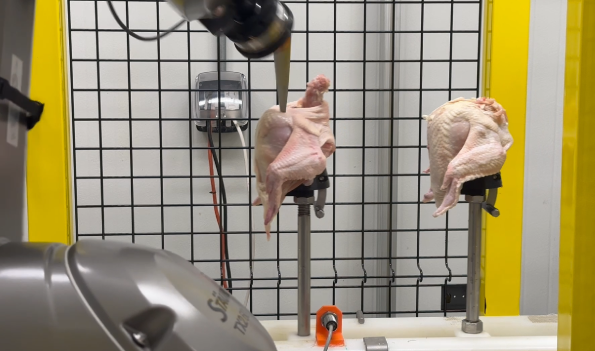 The goal is to optimize meat yield safely. However, no two chickens are alike, and accuracy tends to diminish toward the end of a work shift. “If you’re off by a few millimeters one way or another, you’ll be cutting the cartilage or bone, creating a possible choking hazard,” says Ai-Ping Hu, principal research engineer in the Georgia Tech Research Institute’s Intelligent Sustainable Technologies Division. “If you leave even a nickel’s weight worth of meat, about five grams per carcass, then it equates to losing $1.5 million per plant per year.”
There are chronic labor shortages for this position. So the ATRP has been working on a smart robotic system that could both close that labor gap and far surpass fixed automation systems, which are a significant capital investment with poor meat yields. The rapid advancement of AI technology, combined with $2.2 million in funding from the USDA, has propelled ATRP’s system over the past four years to the point of commercial viability.
First, 3D cameras map the key external features of each chicken that indicate the shoulder joint’s location. Then, patented software algorithms—trained on a thousand birds and counting—use those images to determine the optimal knife path in order to maximize meat yield for each unique bird. The cutting is done by a dexterous robotic arm wielding a knife that’s equipped with a force sensor, which detects the difference between meat and bone. “We’re able to process 38 chickens a minute with a 99.5 percent accuracy rate,” Hu says.
The ATRP is now in talks with potential commercial partners to bring the intelligent cutting system online in Georgia poultry processing plants. “Robots are made to do these tough, difficult jobs,” says Hu. “Being part of that transformation in an industry that plays such a large role in Georgia, and being able to take what we’re working on in the lab and see it out there in the real world, is very gratifying.”
Protecting Poultry
A Georgia Tech team was recently awarded a $2 million, three‑year USDA “HPAI Poultry Innovation Grand Challenge” grant to advance new vaccine strategies for highly pathogenic avian influenza (H5N1). The team will develop an AI‑powered platform to design novel chimeric antigens and rapidly test them using harmless bacteria as delivery vehicles. The collaborative effort spans the Schools of Biological Sciences, Electrical and Computer Engineering, Physics, the Petit Institute for Bioengineering and Bioscience, and the Georgia Tech Research Institute, with GTRI’s David Pattie and Mike Farrell leading the project.